Category: Business Guides

Practical guides for running an exterior cleaning business in the US: pricing, equipment, soft washing, getting customers, and growing a crew.

  • Pressure Washer Trailer Setup: Layout, Weight and Cost Guide (2026)

    Pressure Washer Trailer Setup: Layout, Weight and Cost Guide (2026)

    Disclosure: PowerWashPal may earn a commission if you buy through links on this page, at no extra cost to you. As an Amazon Associate we earn from qualifying purchases. Read how we make money.

    Updated October 2026.

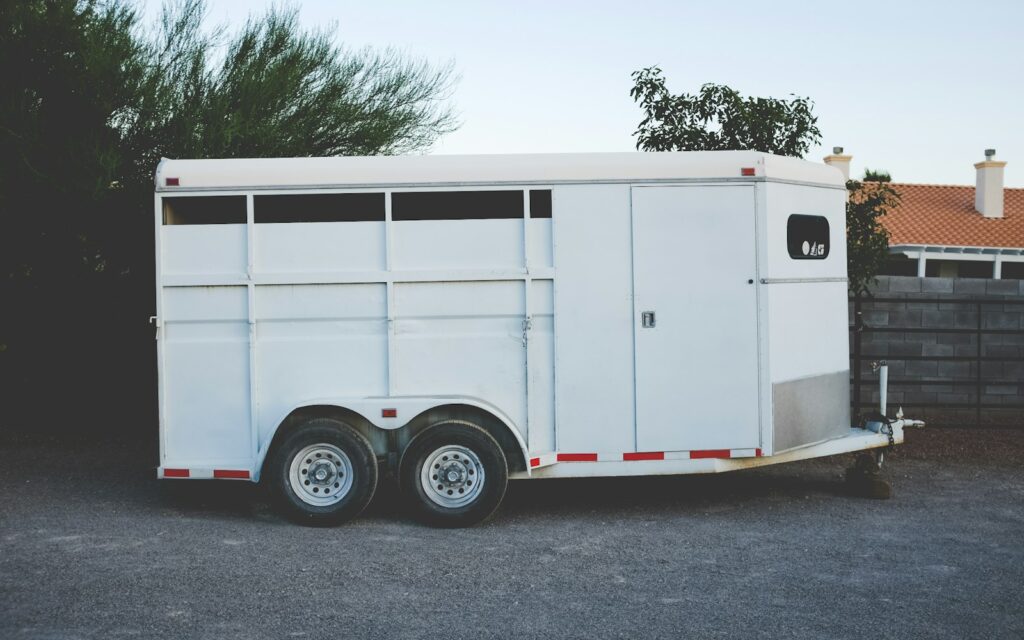
    A good pressure washer trailer setup does three things: it carries enough water to keep your pump fed, it tows safely when that water is full, and it lets you pull hose and start spraying in under five minutes. Most first builds get the first and third parts right and the second part wrong, because water is heavy. A 225-gallon tank holds about 1,877 pounds of water, which is close to the entire payload of a small single-axle utility trailer.

    This guide walks through a pressure washing trailer setup in the order you should plan it: weight first, then the trailer, tank, layout and plumbing, then what it all costs. We didn’t build a rig for this article. The numbers come from manufacturer and dealer pages, trailer listings and contractor forums, and we cite them as we go.

    Start with weight, not equipment

    Water weighs about 8.34 pounds per gallon. That one number decides your trailer, your axle count, whether you need brakes, and sometimes which truck can pull it.

    Water tank (full) Water weight Trigger time at 4 GPM Trigger time at 8 GPM
    100 gallons 834 lb 25 min 13 min
    200 gallons 1,668 lb 50 min 25 min
    225 gallons 1,877 lb 56 min 28 min
    325 gallons 2,711 lb 81 min 41 min
    525 gallons 4,379 lb 131 min 66 min

    Trigger time assumes no refill. On most residential jobs you’ll also have a spigot feeding the tank, so the tank works as a buffer rather than your only supply.

    Now add everything else: the tank itself, the pressure washer (a 4 GPM belt-drive unit like the BE B4013HABG is about 174 lb), hose reels full of hose, a surface cleaner, fuel, chemicals and a soft wash setup. On a small trailer, those “small” items add up to several hundred pounds.
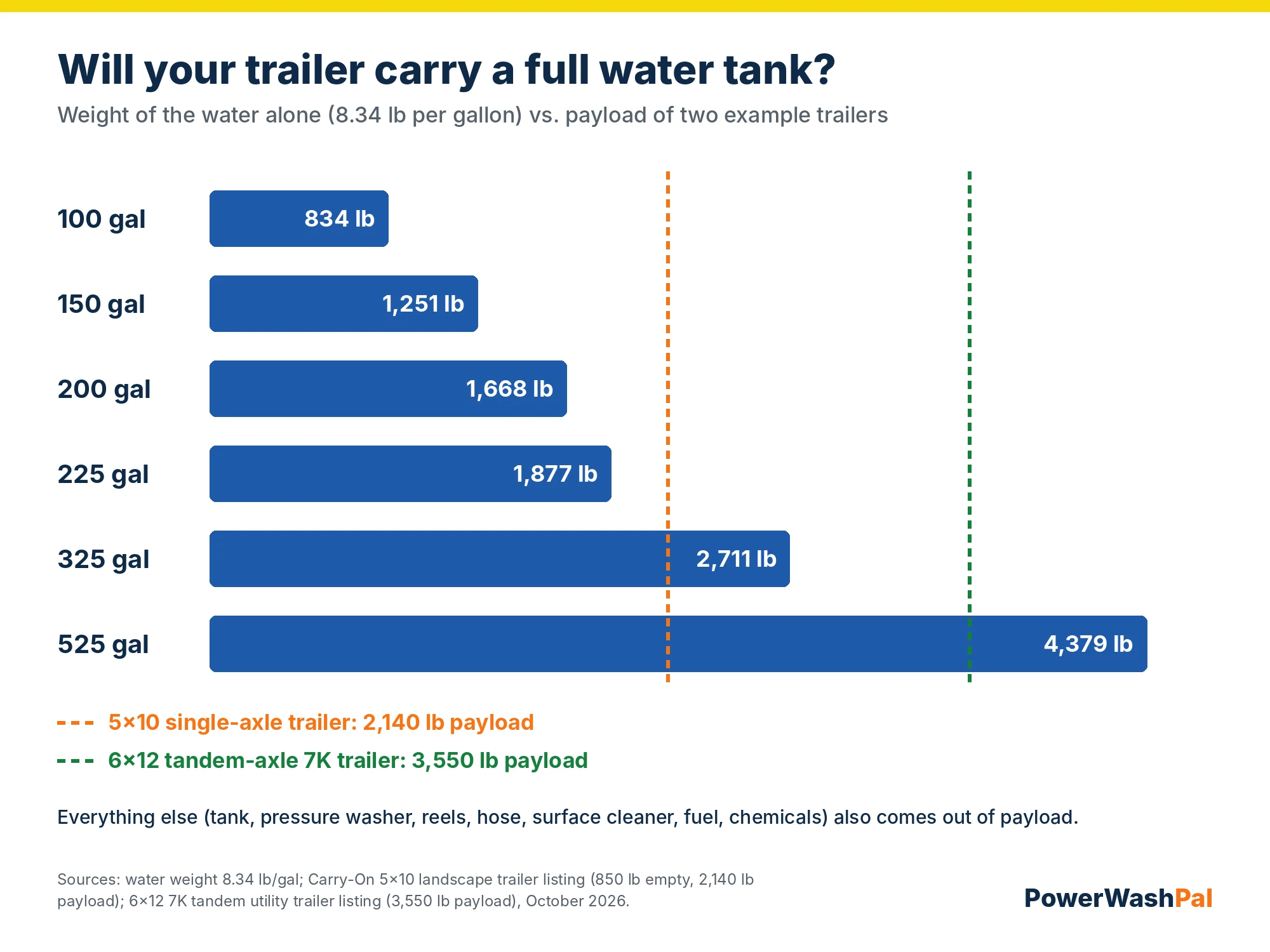
    Bar chart of full water tank weight from 834 lb for 100 gallons to 4,379 lb for 525 gallons, compared with a 2,140 lb payload 5x10 trailer and a 3,550 lb payload 6x12 tandem trailer
    Full water weight by tank size compared with the payload of two example trailers. Water at 8.34 lb/gal; trailer payloads from dealer listings, October 2026.

    Here’s the math on a real example. A Carry-On 5×10 landscape trailer is listed at 850 lb empty with a 2,140 lb payload. Put a 225-gallon tank (1,877 lb of water) and a 174 lb machine on it and you’re at 2,051 lb, leaving about 90 lb for the tank, reels, hose, surface cleaner and fuel. That trailer is overloaded before you leave the shop. The same trailer with a 100- to 150-gallon tank works fine.

    Compare a 6×12 tandem-axle trailer with a 7,000 lb GVWR and electric brakes, listed in October 2026 at $3,665 with a 3,550 lb payload. It carries a 225-gallon setup with room to spare, and even a 325-gallon tank if you keep the rest of the rig light.

    Choosing the trailer

    • 5×8 or 5×10 single axle (about 3,000 lb GVWR): fits residential driveways and tows behind a half-ton pickup or a large SUV. Realistic water capacity is 100 to 150 gallons once everything else is loaded.
    • 6×10 or 6×12 tandem axle (7,000 lb GVWR): the most common choice for a full-time rig. Room for a 200- to 325-gallon tank, a pressure washer, two or three reels and a soft wash system. Tandem axles also handle a blowout better.
    • 7×14 and larger: for 525-gallon tanks, hot water units and multi-gun commercial setups. You’ll need a three-quarter-ton truck or bigger.

    Open vs. enclosed: most contractors run open trailers. Engines get airflow, everything is easy to reach, and the trailer weighs less. Enclosed trailers protect equipment from theft and weather and look cleaner to commercial clients, but they need real ventilation for the engine and burner, and the box adds weight that comes out of your payload.

    Brakes: trailer brake laws are set by each state. Brakes are required above 1,500 lb in states like California and Oregon, above 3,000 lb in most states, and at higher thresholds in a few others, and most states also require a breakaway system. With a full water tank you’ll be over the line in nearly every state, so plan on electric brakes and a brake controller in the truck. Check your state’s rule before you buy (RV Travel keeps a state-by-state list).

    Water tank: size and type

    • 100 to 150 gallons: a buffer tank for residential work where you’ll always have a spigot. It smooths out the supply and protects the pump.
    • 200 to 325 gallons: the sweet spot for most full-time rigs. Enough to finish a driveway or house wash without waiting on a weak spigot, and enough to start a job while the tank refills.
    • 525 gallons and up: commercial flatwork, fleet washing and sites with no water. You need a heavy tandem trailer for this.

    Why carry water at all if the customer has a spigot? Because a typical outdoor faucet often delivers 5 GPM or less, and an 8 GPM machine running straight off a garden hose will starve and cavitate the pump. Even a 4 GPM machine can be short on a long hose run or low water pressure.

    Use a leg tank (a horizontal tank with flat “legs” molded in). It sits low, doesn’t roll, and the legs give the straps something to grip. Prices we saw in October 2026: a Norwesco 225-gallon horizontal leg tank at $1,099.99 at Tractor Supply, and a 235-gallon elliptical leg tank at $787.32 at Sprayer Depot. Get a baffled tank or keep it close to full or close to empty when you tow, because a half-full tank surges hard under braking.

    Layout: where everything goes

    The two rules that matter most are weight placement and reach.

    1. Water tank centered over or just ahead of the axles. It’s the heaviest item and it changes weight all day, so it belongs where it affects tongue weight the least.
    2. About 60% of the load ahead of the axle, 40% behind. Aim for tongue weight of 10 to 15% of the loaded trailer. A tail-heavy trailer sways at highway speed, especially with a full tank behind the axle.
    3. Pressure washer next to the tank, with controls facing the curb side. You want to start the engine and check oil without climbing over hose.
    4. Hose reels at the rear or curb side, so you can pull hose straight off the back toward the house. Stacked reels save space on a 5-foot-wide trailer.
    5. Soft wash tank and pump on the opposite side from the engine to balance side-to-side weight, and away from engine heat.
    6. Surface cleaner, ladders and wands on racks or holsters so nothing slides. Loose gear on a trailer floor gets damaged and damages hose.

    Bolt engines and pumps down with Grade 8 hardware and backing plates, use rubber isolators under the engine mounts, and strap tanks with heavy ratchet straps or steel bands. A 225-gallon tank that shifts in a hard stop weighs as much as a small car.

    Plumbing order

    The order of parts from the tank to the gun matters more than the brand of each part:

    1. Tank outlet with a full-port ball valve, so you can shut off supply for service.
    2. Strainer or inlet filter sized for your pump’s flow. Debris in the tank is the most common cause of a damaged pump.
    3. Suction hose, wire-reinforced and non-collapsible, sized to the pump inlet (1 inch or larger for high-flow pumps). Not a garden hose.
    4. Pump, with the unloader bypass line routed back to the tank rather than looping into the pump inlet. A bypass loop on the pump heats the water during long trigger-off periods and cooks the seals.
    5. Downstream injector after the pump outlet if you apply detergent or mild bleach through the pressure line. Our soft wash system guide covers when a separate 12V pump is the better choice.
    6. High-pressure hose reel with a swivel rated above your machine’s PSI.
    7. Float valve on the tank fill, so a spigot or hydrant tops it off automatically while you work.

    Pressure-test every fitting before your first job, and keep thread sealant out of the pump inlet.

    Equipment checklist

    A typical cold-water trailer rig includes:

    • Pressure washer: 4 GPM or more, belt drive, triplex pump. See our best commercial pressure washer picks. The NorthStar 4200 PSI / 3.5 GPM is one of the few pro-style units sold on Amazon. Check price on Amazon
    • Pressure hose reel with 150 to 200 ft of 3/8″ hose. The Coxreels 112-3-150 is a common trailer reel. Check price on Amazon More options in our hose reel guide.
    • Supply or soft wash reel for 1/2″ hose, like the Coxreels 1125-4-100. Check price on Amazon
    • Surface cleaner, 20 inches for a 4 GPM machine. The BE Whirl-A-Way is a standard pick. Check price on Amazon
    • Downstream injector, like the General Pump injector. Check price on Amazon
    • Soft wash system (optional on day one): a 12V pump, chemical tank and its own reel.
    • Plumbing: ball valves, strainer, suction hose, float valve, bypass line and quick-connects.
    • Mounting: Grade 8 bolts, isolators, straps or bands, wand holsters, a ladder rack.
    • Safety and extras: a fire extinguisher, wheel chocks, LED work lights, and a spare tire.

    Our full pressure washing equipment list covers nozzles, guns and safety gear.

    What a pressure washer trailer setup costs

    Prices vary a lot by region and by how much you build yourself. These are planning ranges based on the listings we checked in October 2026 and the equipment prices in our other guides:

    Item Budget build Mid build Notes
    Trailer $1,500–$2,500 (used or 5×10) $3,500–$4,500 (6×12 tandem, brakes) New 6×12 7K tandem listed at $3,665
    Water tank + bands $300–$600 (100–150 gal) $800–$1,300 (225–325 gal) 225-gal leg tank $1,099.99 at Tractor Supply
    Pressure washer $1,200–$1,800 $1,900–$3,500 BE 4 GPM belt drive $1,934.94 at Kleen-Rite
    Hose reels + hose $300–$600 $800–$1,500 Stainless reels cost more
    Surface cleaner $150–$300 $350–$700
    Soft wash system $0 (add later) $1,000–$1,500 Remco 12V skid $1,495 at CleanFreak
    Plumbing, mounting, misc. $300–$500 $500–$1,000 Our estimate
    Total about $3,750–$6,300 about $8,850–$14,000

    Turnkey rigs cost more because someone else did the welding, plumbing and wiring. One example: Southeast Softwash listed a complete pressure and soft wash trailer build (6×12 or 7×16 tandem with brakes, 200-gallon water tank, 100-gallon SH tank, two 24V soft wash systems, a 5.5 GPM pressure washer, stainless reels and a 20″ surface cleaner) at $24,999 in October 2026. Hot water units add several thousand dollars more.

    If you’re still deciding whether a trailer belongs in your first-year budget, our pressure washing business plan template has a startup cost sheet you can plug these numbers into, and our guide on how to start a pressure washing business explains when it makes sense to upgrade from a truck bed setup.

    Insurance and registration

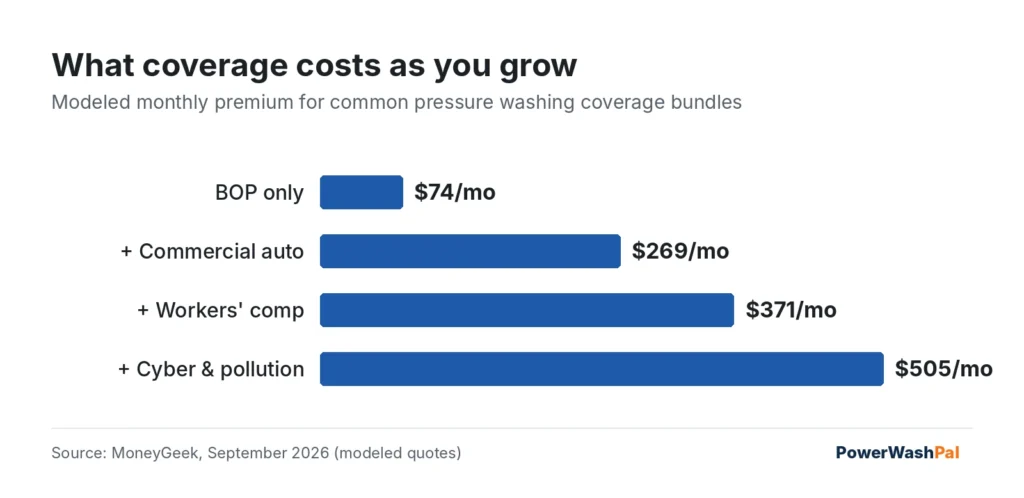
    Register and title the trailer in your state, and tell your insurer about it. Your commercial auto policy should cover the trailer while it’s attached to the truck, and an inland marine or equipment policy covers the gear on it, including theft from a job site. A loaded rig can easily be worth more than the truck that pulls it. Our pressure washing insurance guide covers what each policy costs.

    Common trailer setup mistakes

    • Buying the tank before checking payload. Do the 8.34 lb/gal math first.
    • Towing a half-full tank without baffles. The water surges forward when you brake.
    • Too much weight behind the axle. It lightens the tongue and causes sway.
    • Looping the bypass back into the pump inlet instead of the tank.
    • Using garden hose for suction. It collapses and starves the pump.
    • Skipping winterization. Drain the tank, pump and lines, or run RV antifreeze through them. A cracked pump manifold costs far more than a jug of antifreeze.

    FAQ

    What size water tank do I need for a pressure washing trailer?

    For residential work with a spigot on site, 100 to 225 gallons is plenty. For commercial flatwork or sites without water, 325 to 525 gallons. Match it to your trailer’s payload first: every 100 gallons adds 834 lb.

    Do I need a tandem axle trailer for pressure washing?

    Not for a small buffer tank. Once you carry 200 gallons or more with a commercial machine and reels, a tandem-axle trailer with a 7,000 lb GVWR is the safer choice. It has the payload, it usually comes with brakes, and it’s more stable if a tire fails.

    Does a pressure washing trailer need brakes?

    Almost always once the tank is full. Most states require trailer brakes above 3,000 lb gross weight, and some, like California and Oregon, above 1,500 lb. Check your state’s rule.

    How much does it cost to build a pressure washing trailer?

    A budget build runs roughly $3,750 to $6,300, and a mid-range 6×12 rig with soft wash about $8,850 to $14,000. Turnkey builds cost more: one complete pressure and soft wash trailer was listed at $24,999 in October 2026.

    Can I run my pressure washer straight from the customer’s spigot?

    A small machine can, but a typical spigot often gives 5 GPM or less. A buffer tank with a float valve keeps a 4 to 8 GPM pump fed and protects it from cavitation.

    Should I build a trailer or a truck bed skid?

    A skid keeps everything in your truck and is easier to park. A trailer carries more water, frees up the truck and is easier to upgrade, but it’s harder to back into tight driveways. Most solo operators with a 4 GPM machine start with a skid or a small trailer and move to a 6×12 when they add soft washing or commercial work.
  • Pressure Washing Business Plan: Free Template + Sample Numbers (2026)

    Pressure Washing Business Plan: Free Template + Sample Numbers (2026)

    Disclosure: PowerWashPal may earn a commission if you buy through links on this page, at no extra cost to you. This is general information, not financial or legal advice. Read how we make money.

    Updated October 2026.

    A pressure washing business plan doesn’t need to be 40 pages. If you’re funding the start from savings, five pages that answer a few questions are enough: what you’ll sell, to whom, at what price, how customers will find you, what it costs to start and how many jobs you need to make it worth it. If you’re asking a bank or the SBA for a loan, you’ll need the same plan with more detail in the market and financial sections.

    We built a free power washing business plan template for both cases. It’s a Word document with a guiding note and a worked example in every section, plus an Excel spreadsheet that calculates your startup costs, a 12-month projection and your break-even point. Download them below, then use this guide to fill them in.

    Free pressure washing business plan template

    9-section plan (Word or PDF) + financial spreadsheet with startup costs, 12-month projection and break-even. No email required.

    Download Word (.docx)   Download Excel (.xlsx)   PDF

    What goes in a pressure washing business plan

    Our template follows the traditional structure the U.S. Small Business Administration recommends, adapted for an exterior cleaning company:

    1. Executive summary: the whole plan in half a page.
    2. Company description: legal structure, owner, licenses and insurance.
    3. Services and pricing: what you sell and how you price it.
    4. Market analysis: service area, ideal customers, competitors, SWOT.
    5. Marketing and sales plan: channels, budget and goals.
    6. Operations: rig, equipment, chemicals, software, wastewater plan, safety.
    7. Management and team: who does what, and who you’ll hire.
    8. Financial plan: startup costs, funding, year-one projection, break-even.
    9. Milestones: what you’ll get done in the first 12 months.

    Here’s how to fill in each one, with examples from the sample plan in the template: a one-truck residential company starting in March.

    1. Executive summary

    Write it last, after the numbers are done. In a few sentences, cover what you do, where, for whom, why customers will pick you, how much you need to start and what you expect in year one. A lender may read only this page, so put the key numbers here.

    Sample: “Northside Exterior Wash is a soft washing and pressure washing company serving homeowners and small businesses within 20 miles of [City]. Startup costs are about $6,700, funded from savings. Year one targets 174 jobs at an average of $300, about $52,000 in revenue and $39,000 profit before owner pay.”

    2. Company description

    List your legal name and structure, the owner, your launch date and your licenses and insurance. Most new pressure washing companies form an LLC, which costs $50 to $500 in state filing fees depending on where you live. Check your state and city for a general business license, any contractor registration and local rules on wash water going into storm drains. Our guide on how to start a pressure washing business walks through registration step by step.

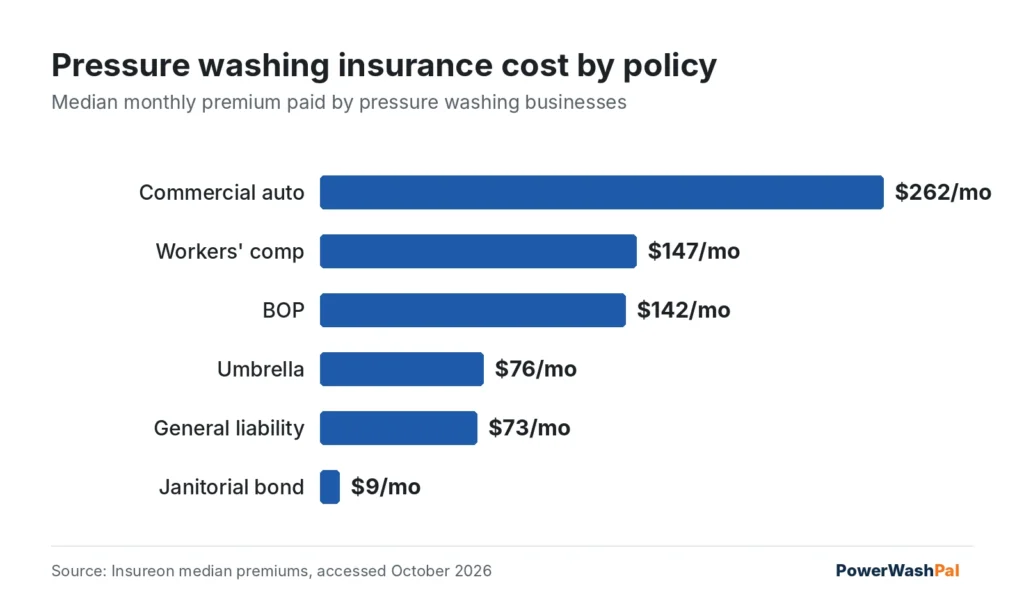
    For insurance, general liability is the minimum. Insureon reports a median of about $73 a month for pressure washing businesses; our insurance guide covers the other policies you’ll need once you hire or buy a work truck.

    3. Services and pricing

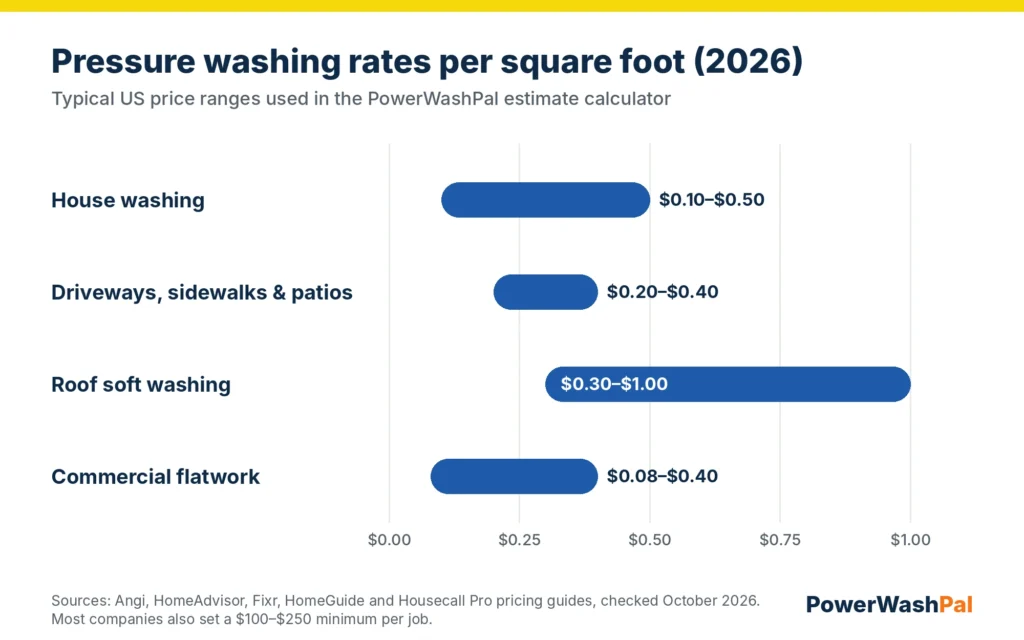
    Start with three to five services you can do well, like house washing, driveways and flatwork, roof soft washing, decks and fences, and decide how you’ll price each. Most companies price by the square foot with a minimum charge:

    Service Common pricing
    House wash $0.10–$0.50 per sq ft of siding
    Driveway / flatwork $0.20–$0.40 per sq ft
    Roof soft wash $0.30–$1.00 per sq ft
    Hourly (when sq ft doesn’t fit) $50–$150 per hour
    Minimum charge $100–$250 per visit

    Our pricing guide explains where those ranges come from, and the estimate calculator turns them into a quote. For roofs, see our roof cleaning cost guide.

    4. Market analysis

    This is where most first-time plans get vague. Make it concrete:

    • Service area: the zip codes or radius you’ll cover. Tighter is better for drive time.
    • Customers: how many homes are in your area and how many are owner-occupied (the Census Bureau’s QuickFacts lists both by city and county), and which neighborhoods have the newer, larger homes that book house washes.
    • Commercial targets: storefronts, restaurants, HOAs, property managers, gas stations and dumpster pads.
    • Competitors: search “pressure washing near me” on Google Maps and note the top five: services, review count and rating, and whether they show prices.
    • Seasonality: in northern states, most revenue lands between April and October. Plan for it.

    For context in a loan application, IBISWorld puts the U.S. pressure washing services industry at about $1.2 billion in revenue across roughly 32,000 businesses. That’s a fragmented market of mostly small operators, which is good news for a newcomer with strong reviews.

    5. Marketing and sales plan

    List each channel with a monthly budget and a goal. A typical launch mix: a Google Business Profile (free) and a push for reviews, door hangers and yard signs around finished jobs, Nextdoor and Facebook, Google Local Services Ads once you have reviews, and direct outreach to property managers. Set targets you can measure, like 30 Google reviews in year one, a 40% quote-to-job close rate and 25% of customers rebooking yearly.

    Our guide to getting pressure washing customers covers each channel in depth.

    6. Operations

    Describe your rig and how a job runs from quote to payment:

    • Equipment: a commercial machine around 4 GPM, a surface cleaner, hose and reel, and a soft wash setup. See our equipment list, commercial pressure washer picks and soft wash system guide.
    • Software: how you’ll quote, schedule, invoice and collect payments. Most small companies use an app like Jobber or Housecall Pro; see our software comparison.
    • Contracts: what customers sign before you start. Our free pressure washing contract template covers scope, payment, pre-existing damage and cancellations.
    • Wastewater: how you’ll keep wash water and chemicals out of storm drains where local rules require it.
    • Capacity: how many jobs a day one rig can realistically do.

    7. Management and team

    For a one-person start, this section is short: you, your experience and the outside help you’ll use (an accountant, an insurance agent, maybe a mentor from your local SCORE chapter, which offers free small business mentoring). Add when you plan to hire your first helper and what you’ll pay. Lenders look closely at the owner’s background, so mention any trade, sales or management experience.

    8. Financial plan

    This is the section lenders read most closely, and the one the spreadsheet does for you. It has four tabs: startup costs, assumptions, a 12-month projection and break-even. Every yellow cell is an input you can change.

    Startup costs

    The sample plan assumes a lean solo start with your own truck:

    Item Sample cost
    Commercial pressure washer (~4 GPM) $2,500
    Surface cleaner, hose, reel, nozzles, gun $800
    Soft wash injector + starter chemicals $300
    Safety gear $150
    LLC / registration $150
    General liability insurance (year one) $880
    Field service software (year one) $348
    Signs, cards, door hangers $400
    Website and domain $150
    Working cash buffer $1,000
    Total $6,678

    A trailer setup with a water tank adds several thousand dollars, and a custom van can run $30,000 or more, so adjust for your rig.

    Year-one projection

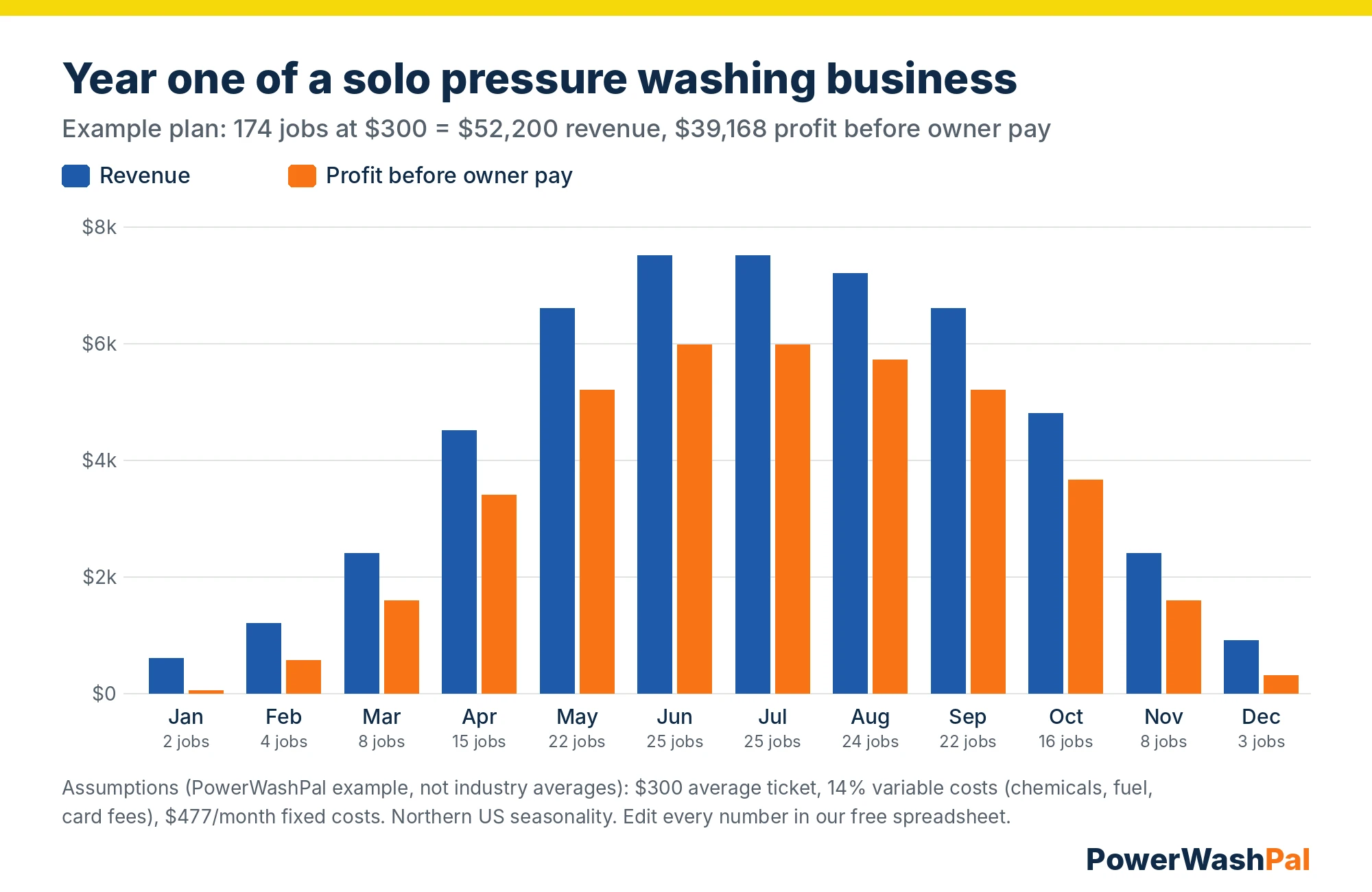
    The sample plan assumes a $300 average ticket, variable costs of 14% of revenue (chemicals 6%, fuel and vehicle 5%, card processing 3%) and $477 a month in fixed costs (insurance, software, phone, marketing, maintenance). With 174 jobs spread across a northern-US season, that’s:

    Example year-one revenue and profit by month for a solo pressure washing business, peaking at $7,500 revenue in June and July
    Year one of the sample plan, month by month. These are example assumptions, not industry averages; change them in the spreadsheet.
    • Revenue: $52,200
    • Variable costs: $7,308
    • Fixed costs: $5,724
    • Profit before owner pay: $39,168, or $32,490 after paying back the startup costs

    Note that this is profit before you pay yourself and before income and self-employment taxes. It also assumes you’re doing the work alone. Adding a helper raises capacity but adds labor, payroll taxes and workers’ comp.

    Break-even

    Each $300 job leaves $258 after variable costs. At $477 a month in fixed costs, you break even at 2 jobs a month, and about 26 jobs pay back the startup costs. To pay yourself $50,000 a year on top of fixed costs, you need about 216 jobs at that ticket. That last number is the useful one: it tells you whether your marketing plan can realistically produce enough work, or whether you need a higher average ticket (roofs, commercial contracts, add-ons) instead of more jobs.

    9. Milestones

    End with a dated list for the first year: registration and insurance done, equipment bought and tested, website and Google profile live, first 10 paying jobs, 25 reviews, first commercial contract, first hire. It keeps you honest, and it shows a lender you have a plan beyond the numbers.

    Tips for a plan that gets used (or funded)

    • Use local numbers. “There are 18,000 single-family homes in my three zip codes” beats “the market is large.”
    • Be conservative on jobs, honest on costs. Most first-year plans overestimate how fast work comes in.
    • Show your pricing math. A sample quote for a typical house tells a lender you know the trade.
    • Plan the slow season. Winter cash flow, holiday lights or gutter cleaning, and a cash buffer.
    • Update it every winter. Compare actual jobs and costs to the plan and reset next year’s targets.

    FAQ

    Do I need a business plan to start a pressure washing business?

    Not legally. But a short plan forces you to price your services, estimate costs and figure out how many jobs you need, which is the difference between a business and an expensive hobby. You’ll need a full plan if you apply for a bank or SBA loan.

    How much does it cost to start a pressure washing business?

    A lean solo start with your own truck runs roughly $3,000 to $7,000; our sample plan comes to $6,678 including a $1,000 cash buffer. A trailer rig or a van pushes it much higher.

    How much can a pressure washing business make in its first year?

    It depends on your market, pricing and how fast you get customers. Our sample plan shows $52,200 in revenue and about $39,000 before owner pay from 174 jobs, but treat that as an example to adjust, not a forecast.

    Is this business plan template free?

    Yes. The Word, PDF and Excel files are free to download and edit, with no email required.

    What’s the difference between a pressure washing and a power washing business plan?

    None in practice. “Power washing” usually means hot water washing and “pressure washing” cold water, but customers use the terms interchangeably, and the plan is the same.

    How long should a pressure washing business plan be?

    Five to ten pages for your own use, 15 to 25 with appendices for a lender. Clear numbers matter more than length.

  • Pressure Washing Contract Template (Free Word + PDF Download)

    Pressure Washing Contract Template (Free Word + PDF Download)

    Disclosure: PowerWashPal may earn a commission if you buy through links on this page, at no extra cost to you. This template is general information, not legal advice. Read how we make money.

    Updated October 2026.

    Most pressure washing contracts get written the week after something goes wrong: a homeowner says you streaked their siding, a property manager won’t pay for a missed visit, or a customer cancels the morning your crew pulls into the driveway. A one-page agreement signed before the job would have settled every one of those in a single text.

    Below is a free pressure washing contract template you can download as a Word file or PDF, edit with your business name and use on your next job. It covers residential work, includes an addendum for recurring commercial accounts, and comes with a pre-job condition checklist and the FTC cancellation notice you need for sales made at a customer’s home. After the download links, we walk through every section so you know what to change and why it’s there.

    Free pressure washing contract template (6 pages)

    Service agreement + recurring/commercial addendum + pre-job condition checklist + Notice of Cancellation. No email required.

    Download Word (.docx)   Download PDF

    What’s in the template

    The download is a fill-in-the-blanks contract. Anything in [brackets] or on a blank line is yours to change. Here’s what each page does:

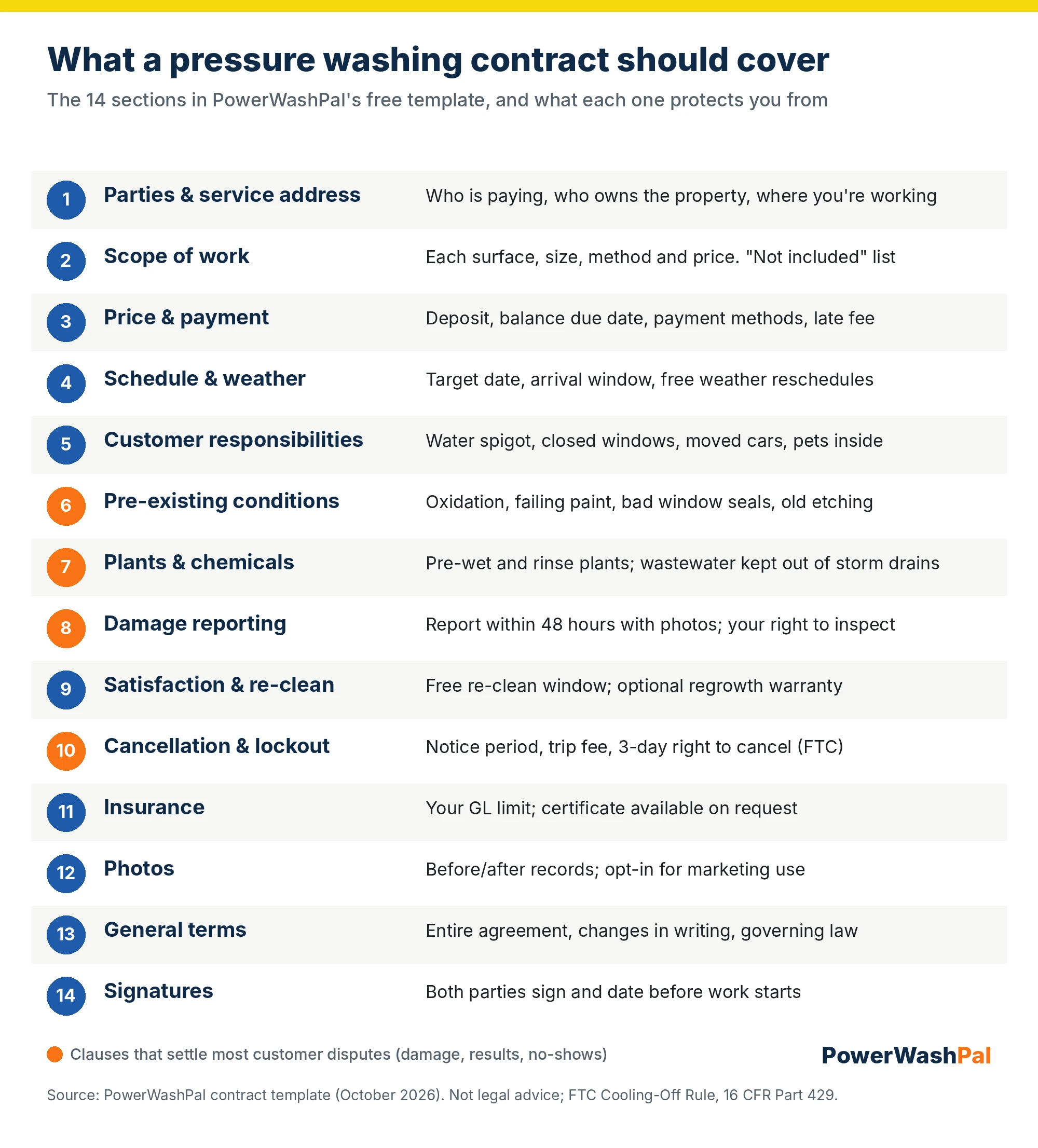
    • Pages 1–3: Service agreement. Fourteen sections, from parties and scope of work to signatures. This is the part every customer signs.
    • Page 4: Addendum A, recurring or commercial service. Visit frequency, term, auto-renewal, after-hours access, net payment terms and annual price changes. Use it for storefronts, restaurants, HOAs, gas stations and property managers.
    • Page 5: Pre-job condition checklist. Twelve things to check and photograph with the customer before you pull the trigger, like chalking siding, fogged window seals and old etching on concrete.
    • Page 6: Notice of Cancellation. Two copies of the cancellation form required by the FTC’s Cooling-Off Rule when you sell a job at the customer’s home.
    Checklist of the 14 sections a pressure washing contract should cover, from parties and scope of work to signatures
    The 14 sections of the PowerWashPal pressure washing contract template. Orange sections are the ones that settle most disputes.

    Do you really need a contract for pressure washing?

    For a $150 driveway, a written quote with your terms attached is usually enough. Once you’re washing houses, roofs or anything commercial, a signed agreement is worth the two minutes it takes. Here’s why:

    • Damage claims. Cleaning exposes problems that were already there: oxidized siding, paint that was barely hanging on, window seals that were already failing. Without a pre-existing conditions clause and before photos, it’s your word against the customer’s.
    • Getting paid. A deposit and a clear due date cut down on “I’ll pay you next week.” Commercial clients expect net terms in writing anyway.
    • Scope creep. “While you’re here, can you hit the back patio?” is fine when the contract says extra work gets priced before you do it.
    • Bigger clients ask for it. Property managers and HOAs often won’t hire a contractor without a signed service agreement and a certificate of insurance.

    A contract won’t replace insurance, and it won’t save you from your own negligence. What it does is put the normal risks of the job in writing so neither side is surprised.

    What pressure washing contracts should include

    These are the sections in our template, in order, with notes on how to fill them in.

    1. Parties and property

    Your legal business name, address, phone and email; the customer’s name, service address and billing address. Add a line confirming the customer owns the property or has permission to authorize the work. That matters for rentals, condos and HOA-maintained buildings, where the person who calls you isn’t always the person who can say yes.

    2. Scope of work

    This is where most disputes start, so be specific. The template has a row for each common service (house wash, roof, flatwork, deck or fence, gutter brightening, windows, stain treatment) with columns for the area, the method and the price. Write the square footage or linear feet you measured, and say whether you’re soft washing or pressure washing each surface.

    Just as important is the “not included” line: sealing, painting, repairs, interior windows, and rust, oil or fertilizer stain removal unless you listed it. If you need help putting numbers in the price column, our pressure washing estimate calculator and pricing guide cover per-square-foot rates for each surface.

    3. Price and payment

    Fill in the total, the deposit, when the balance is due and how you accept payment. The template also says the price is based on the conditions you saw at the estimate. If the job turns out to be very different (a second story nobody mentioned, heavy moss on the north side), you explain the change and get an OK before doing the extra work. That one sentence prevents a lot of awkward invoices.

    A few notes on fees. Credit card surcharges are restricted in some states, and late fees are capped by state law, so check yours before you fill in those blanks.

    4. Schedule and weather

    Give a scheduled date and an arrival window instead of an exact time. Then reserve the right to reschedule for rain, high wind or freezing temperatures at no cost to the customer. Also say whether the customer needs to be home. For most house washes they don’t, as long as the water and gates are accessible.

    5. Customer responsibilities

    A short list of things the customer agrees to do before you arrive: provide a working spigot, close windows, move cars and patio furniture, keep pets inside, and tell you about known problems like leaking windows, loose siding, landscape lighting or a septic system. When a crew shows up to a locked gate and a car parked on the driveway, this is the clause that backs up your trip fee.

    6. Pre-existing conditions and results

    This is the clause that protects you most. It lists the problems cleaning can reveal but doesn’t cause, such as chalking or oxidized siding, failing paint, worn caulk, fogged window seals and old etching or “zebra striping” on concrete. It also covers stains you’ll try to remove but can’t guarantee (rust, oil, fertilizer, tannin, efflorescence) and the fact that mold and algae eventually grow back.

    Pair it with the condition checklist on page 5. Walk the property with the customer, check the boxes, take dated photos and get their initials. It takes five minutes and it’s the best evidence you’ll have if a claim ever comes up.

    7. Plants, property and cleaning solutions

    Say that you pre-wet and rinse landscaping, use labeled cleaning solutions according to the label, and follow local wastewater rules. Many cities restrict wash water going into storm drains, and commercial sites often require water recovery, so the customer should point out drains, ponds and wells. The clause makes you responsible for damage caused by your own negligence, which is fair and easier to enforce than a promise that you’re never responsible for anything.

    8. Damage reporting

    Give the customer a window to report damage (48 hours is common), require photos, and keep the right to inspect before you pay for anything. You then choose whether to repair it, pay a qualified pro or reimburse the reasonable cost. This stops the “my gutter was fine until you came” call three weeks later.

    9. Satisfaction and re-cleaning

    Offer a free re-clean if the customer reports a problem within a set number of days. It costs you a short return trip and it turns a potential bad review into a good one. If you sell roof or house washes with a regrowth warranty, put the length in writing here.

    10. Cancellation, lockouts and the 3-day rule

    Set a notice period for cancellations (24 to 48 hours is typical) and a trip fee for lockouts, when the crew arrives but can’t work because there’s no water, a locked gate or cars in the way.

    If you close sales at the customer’s home, read this part carefully. Under the FTC’s Cooling-Off Rule, a sale of $25 or more made at the buyer’s home gives them until midnight of the third business day to cancel for a full refund. You have to tell them about that right in the contract and hand them two copies of a cancellation form. The template includes the required statement near the signatures and a two-copy Notice of Cancellation on page 6. Sales made entirely by phone, online or at your place of business aren’t covered by the federal rule, but some states have their own home-solicitation laws with longer periods. Check the FTC’s summary of the rule and your state’s version.

    11. Insurance

    State your general liability limit and that a certificate is available on request. Most small exterior cleaning businesses carry $1 million per occurrence. If you have employees, note workers’ comp too. Our pressure washing insurance guide covers what each policy costs.

    12. Photos

    You’ll want before and after photos for your records either way. Using them in marketing is different, so the template makes it an opt-in checkbox and promises you won’t show house numbers, plates or people.

    13. General terms

    The boilerplate: you’re an independent contractor, this document is the whole agreement, changes must be in writing (a text or email counts), and your state’s law applies. Fill in your state.

    14. Signatures

    Both of you sign and date before work starts. An e-signature in your field service software counts too (more on that below).

    Residential vs. commercial pressure washing contracts

    The main agreement works for both, but commercial and recurring work brings a few extra terms. That’s what Addendum A is for.

    Term Residential one-time job Commercial / recurring
    Pricing One total, by surface Price per visit, per location
    Payment Deposit + balance on completion Monthly invoice, net 15–30
    Schedule One date, arrival window Weekly / monthly / quarterly, often after hours
    Term Ends when the job is done Fixed term, auto-renewal, notice to terminate
    Insurance Certificate on request Often must name client as additional insured
    Wastewater Rinse plants, avoid drains Water recovery may be required on site
    3-day cancellation notice Needed if sold at the home Usually not (business purchase)

    Recurring commercial contracts are where the steady money is. Our pricing guide notes that recurring agreements are usually priced 15–30% below one-time rates, and the guide to getting pressure washing customers covers how to land them.

    How to use the template

    1. Download the Word file and replace every [bracket] with your details. Add your logo at the top if you have one.
    2. Set your defaults: deposit percentage, payment terms, cancellation notice, trip fee, re-clean window and your state.
    3. Have a local attorney review it once. Contract, late fee and consumer protection rules vary by state. A one-time review usually costs far less than one disputed job.
    4. Save a master copy and fill in a fresh one per job: scope, price, date and walk-around notes.
    5. Walk the property with the customer, fill in the condition checklist and take photos.
    6. Get it signed before you start, on paper or by e-signature, and give the customer a copy. For sales at their home, include both copies of the Notice of Cancellation.

    Sending contracts from your software

    Printing contracts gets old once you’re doing more than a few jobs a week. Field service software lets you put your terms on every quote and have customers approve them online. In Jobber, for example, you can add your standard terms to the contract/disclaimer section of quotes and invoices, and customers approve the quote online through the client hub. Housecall Pro offers online estimate approval too. Either way, you keep a time-stamped record of what the customer agreed to.

    A practical setup: paste sections 3 through 13 of the template into your quote terms, and keep the condition checklist and Addendum A as attachments for the jobs that need them. Our pressure washing software comparison and Jobber review cover which tools handle quotes, approvals and deposits best.

    Try Jobber free for 14 days

    Common contract mistakes

    • A vague scope. “Wash house” invites arguments. “Soft wash siding, soffits and trim, 2,200 sq ft, two stories, front porch ceiling included” doesn’t.
    • No before photos. The pre-existing conditions clause is much weaker without dated photos.
    • Guaranteeing stain removal. Rust and oil stains are often permanent. Promise a good-faith attempt, not a result.
    • Skipping the cancellation notice on door-to-door or at-home sales. Leaving it out breaks the federal rule, and in some states it gives the customer longer to cancel.
    • Copying a contract from another state without checking your own rules on late fees, card surcharges and home solicitation sales.
    • Signing after the work. A contract signed once the driveway is already clean protects nobody.

    FAQ

    Is this pressure washing contract template really free?

    Yes. Download the Word or PDF file, edit it and use it for your business. No email or signup required. If you share it, a link back to this page is appreciated.

    Is the template legally binding?

    A contract is generally binding when both parties agree to clear terms and sign it, but rules vary by state. Treat this as a starting point and have a local attorney review your final version. This page isn’t legal advice.

    Do I need a different contract for commercial pressure washing?

    Use the same agreement and attach Addendum A. It adds visit frequency, term and renewal, termination notice, net payment terms, after-hours access and additional insured requirements.

    Can customers sign pressure washing contracts electronically?

    In most cases, yes. The federal E-SIGN Act gives electronic signatures the same legal effect as paper ones for most contracts. Field service apps like Jobber and Housecall Pro let customers approve quotes online, which keeps a record of what they agreed to.

    What’s the difference between a pressure washing contract and an estimate?

    An estimate tells the customer what the job should cost. A contract adds the terms: payment, scheduling, responsibilities, damage, cancellation and signatures. Many companies combine the two by attaching their terms to the estimate and asking the customer to approve it.

    How long should a commercial pressure washing contract last?

    Twelve months with automatic renewal and a 30-day termination notice is a common setup. It gives you predictable revenue and gives the client an easy way out, which makes them more likely to sign.

  • Best Commercial Pressure Washer (2026): 4,000 PSI and Hot Water Picks

    Best Commercial Pressure Washer (2026): 4,000 PSI and Hot Water Picks

    Disclosure: PowerWashPal may earn a commission if you buy through some links on this page, at no extra cost to you. As an Amazon Associate we earn from qualifying purchases. How we make money.

    Updated October 2026. Specs and prices come from manufacturer pages and authorized dealers, checked this month. We compare equipment through research, not hands-on testing. Here’s how we compare products.

    The best commercial pressure washer for a cleaning business is a 4,000 PSI, 4 GPM gas machine with a Honda GX390 engine and an industrial triplex pump. That combination is what most residential and light commercial crews run every day, because it cleans fast, parts are everywhere and it holds up to hours of use. Hot water units and belt-drive skids make sense once you take on grease, fleets or full-time commercial contracts.

    Below are the commercial pressure washers we’d shortlist in 2026, what separates a commercial machine from a homeowner model, and how to choose between cold water, hot water, direct drive and belt drive.

    Quick picks

    Best for Machine Specs
    Best overall 4,000 PSI machine SIMPSON PowerShot PS4240 4,200 PSI, 4.0 GPM, Honda GX390, AAA triplex pump
    Best pro-grade build BE Pressure B4013HABG 4,000 PSI, 4.0 GPM, Honda GX390, General Pump TSS1511, aluminum frame
    Best available on Amazon NorthStar 4200 PSI Honda 4,200 PSI, 3.5 GPM, Honda GX390, CAT 66DX pump
    Best hot water Mi-T-M HSP-3504-3MGH 3,500 PSI, 3.3 GPM, Honda GX390, diesel or kerosene burner, 200°F max
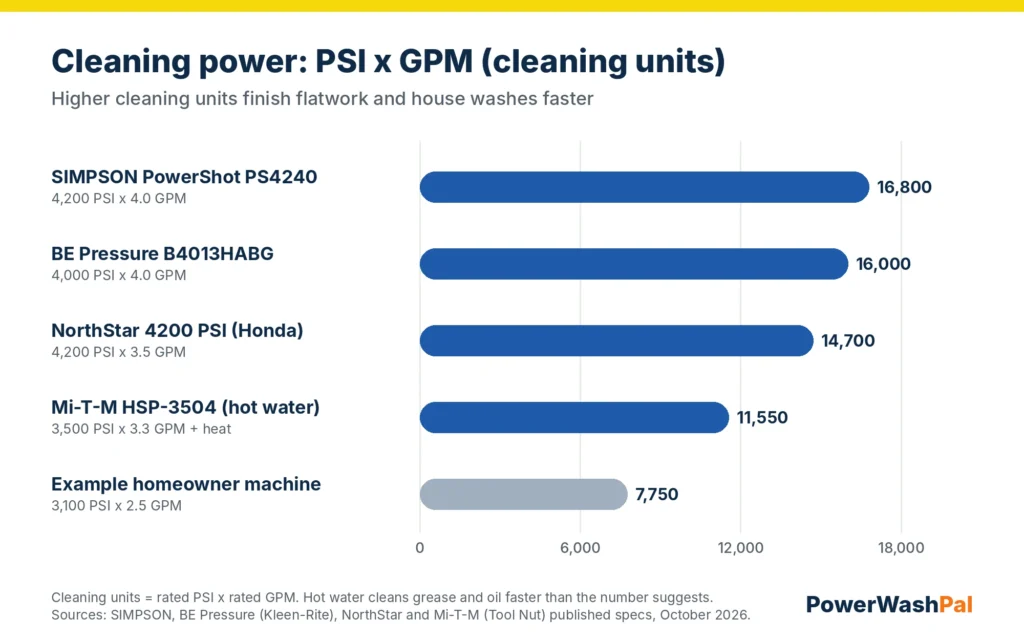
    Chart comparing commercial pressure washers by cleaning units, PSI times GPM
    Cleaning units (PSI x GPM) from published specs, October 2026.

    What makes a pressure washer “commercial”?

    Homeowner and commercial machines can show similar PSI numbers on the box. The difference is what’s underneath and how long it lasts.

    • Flow (GPM): commercial units usually push 3.5–4 GPM or more. Flow rinses dirt away and does most of the work on concrete and siding.
    • Triplex plunger pump: industrial pumps from AAA, General Pump, CAT and Comet have oil-bathed crankcases and serviceable parts, unlike the sealed axial pumps on most consumer machines.
    • Commercial engine: the Honda GX390 (389cc) is the industry standard, which makes parts and service easy to find.
    • Frame, hose and gun: welded steel or aluminum frames, steel-braided 3/8-inch hose and industrial guns built for all-day use.
    • Warranty: longer pump and frame coverage. SIMPSON, for example, lists a 5-year limited pump and 10-year limited frame warranty on the PS4240.

    PSI x GPM: compare machines by cleaning units

    Multiply PSI by GPM to get “cleaning units,” a simple way to compare machines. A 4,000 PSI, 4.0 GPM machine has 16,000 cleaning units, more than double a typical 3,100 PSI, 2.5 GPM homeowner unit. More cleaning units means faster flatwork, faster rinsing and more work done per day.

    The best commercial pressure washers

    SIMPSON PowerShot PS4240: best overall 4,000 PSI machine

    The PS4240 is rated at 4,200 PSI and 4.0 GPM, with a Honda GX390 engine (with low oil shutdown) and an AAA industrial triplex plunger pump. It comes with a 3/8-inch by 50-foot steel-braided hose, five quick-connect tips, 13-inch pneumatic tires and a welded steel frame. SIMPSON lists a 3-year limited engine, 5-year limited pump and 10-year limited frame warranty.

    • Good for: owner-operators who want a proven 4 GPM machine they can buy locally.
    • Watch out for: it’s a cart unit, so plan how you’ll secure it on a trailer or truck.

    Sold through SIMPSON dealers and retailers such as Tractor Supply.

    BE Pressure B4013HABG: best pro-grade build

    BE’s B4013HABG pairs a Honda GX390 with a General Pump TSS1511 triplex pump (forged brass manifold, thermal release valve) for 4,000 PSI at 4.0 GPM. It has a lightweight, corrosion-resistant aluminum frame, 12-inch flat-free wheels, an external unloader and a 50-foot hose, and weighs 174 pounds. Kleen-Rite listed it at $1,934.94 in October 2026, against a $3,212 MSRP.

    • Good for: crews who want a machine built from the same parts their repair shop stocks.
    • Watch out for: stock comes and goes at dealers.

    Sold through pressure washing equipment dealers.

    NorthStar 4200 PSI Honda: best commercial machine on Amazon

    Most pro machines aren’t sold on Amazon, but this NorthStar is. It’s rated at 4,200 PSI and 3.5 GPM, with a Honda GX390 engine and a CAT 66DX direct-drive triplex pump with thermal protection and ceramic plungers. Oil drain cutouts make engine and pump oil changes cleaner, and adjustable pressure lets you turn it down for softer surfaces.

    • Good for: buyers who want Amazon delivery and returns.
    • Watch out for: 3.5 GPM is a little less flow than the 4 GPM machines above.

    Check price on Amazon

    Mi-T-M HSP-3504-3MGH: best hot water pressure washer

    For grease, oil, gum and fleet work, hot water cleans far faster than cold. Mi-T-M’s HSP-3504-3MGH is rated at 3,500 PSI and 3.3 GPM with a Honda GX390 and a direct-drive AR pump. Its burner runs on No. 1 or No. 2 diesel or kerosene, puts out 294,000 BTU per hour and heats water up to 200°F (a 150°F rise over incoming water). It weighs 428 pounds and Tool Nut listed it at $5,320.99 in October 2026.

    • Good for: restaurants, dumpster pads, drive-thrus, fleets and equipment.
    • Watch out for: heavy, expensive and two fuels to manage; most residential crews don’t need one.

    Sold through Mi-T-M dealers and industrial suppliers.

    Best commercial pressure washer by industry

    The right machine depends on what you clean. Use this as a starting point, then match PSI and GPM to the job.

    Food industry and restaurants

    Grease and fat need heat. A hot water unit like the Mi-T-M HSP-3504-3MGH is the usual pick for dumpster pads, drive-thrus and kitchen exhaust areas. For indoor work, choose an electric hot water model, since gas engines and burners create exhaust. Pair it with a food-safe degreaser and check local wastewater rules before you rinse.

    Construction companies

    Mud, concrete splatter and heavy equipment call for high flow more than heat. A belt-drive, cold water gas machine at 4 GPM, like the BE B4013HABG, handles daily use and is easier to service on site.

    Municipalities and fleets

    Cities clean sidewalks, graffiti, buses and garbage trucks. Hot water plus a trailer or skid setup saves time on oil and diesel grime. See our pressure washer trailer setup guide.

    Oilfield and heavy industry

    Crude, drilling mud and hydraulic fluid need hot water, often near the top of the burner’s range. Look for an industrial hot water skid with a diesel burner, a triplex pump and a hose rated for the water temperature.

    How we chose

    We didn’t test these machines ourselves. We compared published specs (PSI, GPM, engine, pump brand and type, frame, warranty), dealer listings from Kleen-Rite and Tool Nut, and reviews and discussions from working contractors. We only included machines with industrial triplex pumps and commercial engines from established brands.

    Hot water vs cold water

    Cold water Hot water
    Best for Houses, driveways, decks, fences, roofs (with soft wash) Grease, oil, gum, fleets, restaurants, equipment
    Example price (Oct 2026) $1,934.94 (BE B4013HABG at Kleen-Rite) $5,320.99 (Mi-T-M HSP-3504-3MGH at Tool Nut)
    Example weight 174 lb (BE B4013HABG) 428 lb (Mi-T-M HSP-3504-3MGH)
    Fuel Gasoline Gasoline plus diesel or kerosene for the burner

    Most new pressure washing businesses start with a 4 GPM cold water machine and add hot water when commercial accounts justify it. The right insurance matters more as you take on commercial properties, so check your coverage before bidding them.

    Direct drive vs belt drive

    On a direct-drive machine, the pump bolts straight to the engine shaft and spins at engine speed. It’s lighter, simpler and cheaper, which is why most cart units use it. A belt-drive machine runs the pump through pulleys at a lower speed than the engine, which reduces heat and wear on the pump. Belt drives cost more and weigh more, but they’re common on skids and trailers that run all day.

    Build out the rest of your rig

    A commercial pressure washer needs the right accessories to earn its keep: a 20-inch surface cleaner for flatwork, a hose reel for 150–200 feet of 3/8-inch hose, and a soft wash setup for houses and roofs. See our pressure washing equipment list, the best pressure washer hose reels and the best soft wash systems. For flatwork, the BE Whirl-A-Way 20-inch surface cleaner is a common first upgrade.

    Once the equipment is paid for, the money comes from booking enough jobs at the right price. Use our pressure washing estimate calculator to quote on the spot, and see the best pressure washing software for scheduling and invoicing.

    Try Jobber free for 14 days

    Mounting a commercial machine on a trailer? Our pressure washer trailer setup guide covers tank size, weight, layout and what a full rig costs.

    Frequently asked questions

    What is the best commercial pressure washer for a new business?

    A 4,000 PSI, 4 GPM gas machine with a Honda GX390 and an industrial triplex pump, such as the SIMPSON PowerShot PS4240 or BE Pressure B4013HABG. It covers houses, driveways and light commercial work.
    Is a 4,000 PSI pressure washer good for business use?

    Yes, as long as the flow is around 4 GPM and it has a commercial engine and triplex pump. PSI alone doesn’t tell you how fast a machine cleans; GPM matters just as much.

    How many GPM do I need for commercial pressure washing?

    Most contractors want at least 4 GPM for residential and light commercial work. Larger skids and trailer rigs often run more.
    Do I need a hot water pressure washer?

    Only if you clean grease, oil or heavy grime regularly, such as restaurants, fleets or equipment. For houses, driveways and roofs, cold water plus the right chemicals is the standard.

    How much does a commercial pressure washer cost?

    As an example, in October 2026 Kleen-Rite listed the 4 GPM BE Pressure B4013HABG at $1,934.94, and Tool Nut listed the Mi-T-M HSP-3504-3MGH hot water unit at $5,320.99. Prices change often, so check dealers before you buy.

    What is the difference between a commercial and an industrial pressure washer?

    There is no official standard, so the labels vary by seller. In practice, “commercial” usually means a pro-grade gas machine with a commercial engine and triplex pump, while “industrial” is often used for heavier-duty units such as hot water machines and larger skid or trailer rigs. Compare the engine, pump, GPM and warranty instead of trusting the label.

    How much does a commercial pressure washing machine cost?

    In October 2026, the BE B4013HABG was listed at about $1,935 at Kleen-Rite, and the Mi-T-M HSP-3504-3MGH hot water unit at about $5,321 at Tool Nut. Dealer prices change, so check the current listing before you buy.

    What commercial pressure washing equipment do you need besides the machine?

    You also need hose, a reel, nozzles, a surface cleaner and a soft wash setup. Our pressure washing equipment list covers the full rig.

  • Roof Cleaning Cost (2026): What Homeowners Pay and What Pros Should Charge

    Roof Cleaning Cost (2026): What Homeowners Pay and What Pros Should Charge

    As an Amazon Associate I earn from qualifying purchases. Some of the links in this article are affiliate links — if you buy through them, we may earn a commission at no extra cost to you.

    Disclosure: PowerWashPal may earn a commission if you sign up through some links on this page, at no extra cost to you. How we make money.

    Updated October 2026. Prices come from published US cost guides from This Old House (updated March 2026), Fixr and HomeGuide, checked this month.

    Roof cleaning cost in the US averages about $600–$675 for a typical 1,500-square-foot roof, with most jobs falling between $300 and $1,050. Per square foot, homeowners usually pay $0.20–$0.70, and soft washing, the method most shingle and tile roofs need, runs about $0.30–$0.75.

    This guide is written for roof cleaning and soft washing companies deciding how much to charge, but it works just as well if you’re a homeowner checking a quote. We cover cost by roof size, method and material, the adjustments pros make for pitch and height, and a quick calculator that turns a home’s footprint into a roof cleaning price.

    Roof cleaning cost at a glance

    Typical costSource
    Average job (1,500 sq ft roof)$600–$675This Old House
    Typical range$300–$1,050This Old House
    National average (all sizes)$440HomeGuide
    Per square foot, all methods$0.20–$0.70This Old House
    Soft wash per square foot$0.30–$0.75This Old House, Fixr
    Separate moss prevention treatment$100–$250HomeGuide, Fixr

    Sources don’t agree perfectly. HomeGuide puts soft washing lower, at $0.15–$0.60 per square foot, while This Old House and Fixr put it at $0.30–$0.75. That spread is normal: prices vary a lot by region, roof pitch and how bad the algae or moss is.

    Roof cleaning cost calculator

    Enter the home’s footprint (the ground-floor area, or the roof area if you already know it), pick the roof pitch and material, and the calculator estimates roof area and a low, typical and high price.

    Estimated roof area: 0 sq ft
    Low$0
    Typical$0
    High$0
    Rates per sq ft: soft wash $0.30–$0.75, low pressure $0.30–$0.70, metal $0.20–$0.60, chemical wash $0.20–$0.30 (This Old House, March 2026). Story add-on based on Fixr and This Old House. Roof area = footprint x pitch factor; overhangs, dormers and porches add more.

    Need to price a roof together with a house wash and driveway? Use our full pressure washing estimate calculator.

    Roof cleaning cost by roof size

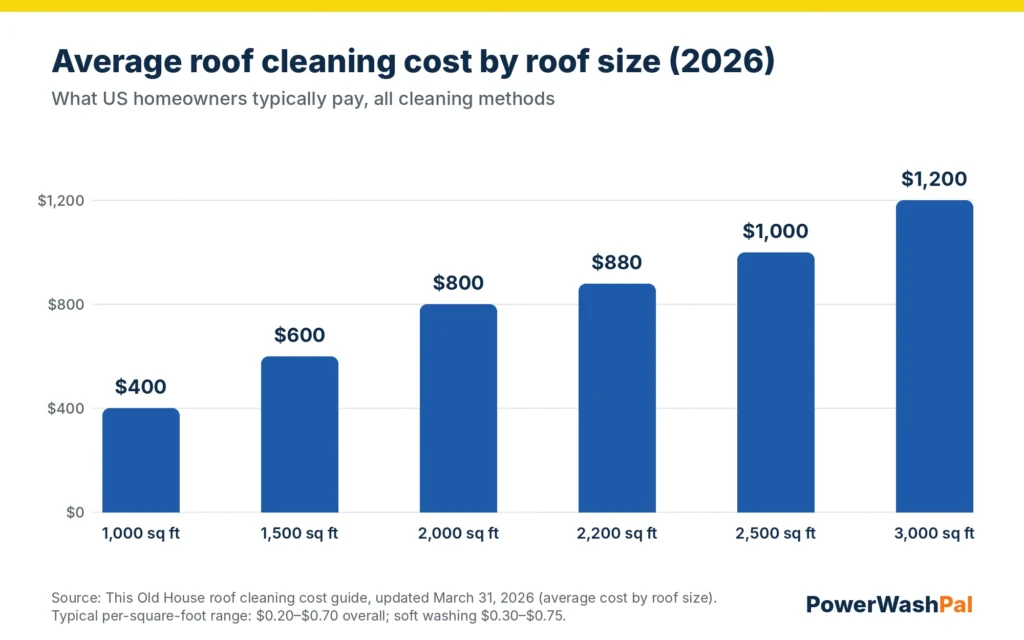
    Roof sizeTypical rangeAverage
    1,000 sq ft$50–$750$400
    1,500 sq ft$75–$1,125$600
    2,000 sq ft$100–$1,500$800
    2,200 sq ft$110–$1,650$880
    2,500 sq ft$125–$1,875$1,000
    3,000 sq ft$150–$2,250$1,200

    Source: This Old House, updated March 31, 2026. The low end of each range reflects simple methods like blowing debris off, not a full soft wash.

    Bar chart of average roof cleaning cost by roof size from 1,000 to 3,000 square feet in 2026
    Average roof cleaning cost by roof size. Source: This Old House, March 2026.

    Roof cleaning cost by method

    MethodPer sq ftBest for
    Blower cleaning$0.05–$0.10Leaves and loose debris only
    Chemical wash$0.20–$0.30Rubber, tar and gravel
    High-pressure wash$0.20–$0.60Metal roofs
    Low-pressure wash$0.30–$0.70Wood shakes, slate
    Soft wash$0.30–$0.75Asphalt shingles, clay and concrete tile

    Source: This Old House, March 2026. Fixr notes moss and algae removal is usually included in a soft wash or chemical clean, so it's rarely a separate line item unless you add a preventive treatment.

    Soft washing is the standard for shingle roofs because high pressure can strip granules and void warranties. The Asphalt Roofing Manufacturers Association advises against power washing asphalt shingles. Read our soft washing vs pressure washing guide for the details.

    How much to charge for roof cleaning (for contractors)

    National averages tell you what homeowners expect to see. Your own price has to cover chemicals, labor, travel and risk on a roof. Here's a simple way to build it.

    1. Measure roof area, not the footprint

    A roof is bigger than the home's footprint because of pitch. Multiply the footprint by a pitch factor: about 1.05 for a 4/12 pitch, 1.12 for 6/12, 1.20 for 8/12, 1.30 for 10/12 and 1.41 for 12/12. Add overhangs, dormers and porch roofs if they're large. Satellite tools are accurate enough to quote from.

    2. Start from a per-square-foot rate for the method

    For soft washing, most published ranges sit between $0.30 and $0.75 per square foot. New companies often start near the middle and raise prices as reviews and demand grow.

    3. Add for height and pitch

    Fixr and This Old House both show about $0.10 more per square foot for each extra story. HomeGuide lists steep roofs at $0.15–$0.20 more per square foot. Steep or high roofs need more setup, more safety gear and more time.

    4. Set a minimum

    HomeGuide puts the low end of roof cleaning at about $150, but almost no roof job is worth doing for that once you count drive time, setup, chemical and cleanup. Many companies set a roof minimum well above their flatwork minimum.

    5. Bundle gutters and house washes

    HomeGuide lists gutter cleaning at $110–$185 and notes many companies discount when gutters and the roof are done in the same visit. Bundling a roof soft wash with a house wash and gutters raises the ticket without adding another trip.

    For the bigger picture on pricing every service you offer, read how much to charge for pressure washing.

    What drives roof cleaning prices up or down

    • Roof size and pitch: more area and steeper slopes mean more chemical and more time.
    • Number of stories: taller homes need more reach and more safety setup.
    • Material: tile, slate and wood need gentler, slower methods.
    • Growth level: heavy moss may need a second application or manual removal.
    • Access: landscaping to protect, tight lots and no nearby water add time.
    • Add-ons: moss prevention treatments ($100–$250), zinc strips ($30–$60 per 50-foot roll per HomeGuide) and gutter cleaning.

    How often should a roof be cleaned?

    HomeGuide recommends cleaning a roof every one to three years. Homes in shady, humid areas usually need it more often, which makes roof cleaning a strong recurring service. A typical job takes two to five hours.

    Safety gear for roof cleaning

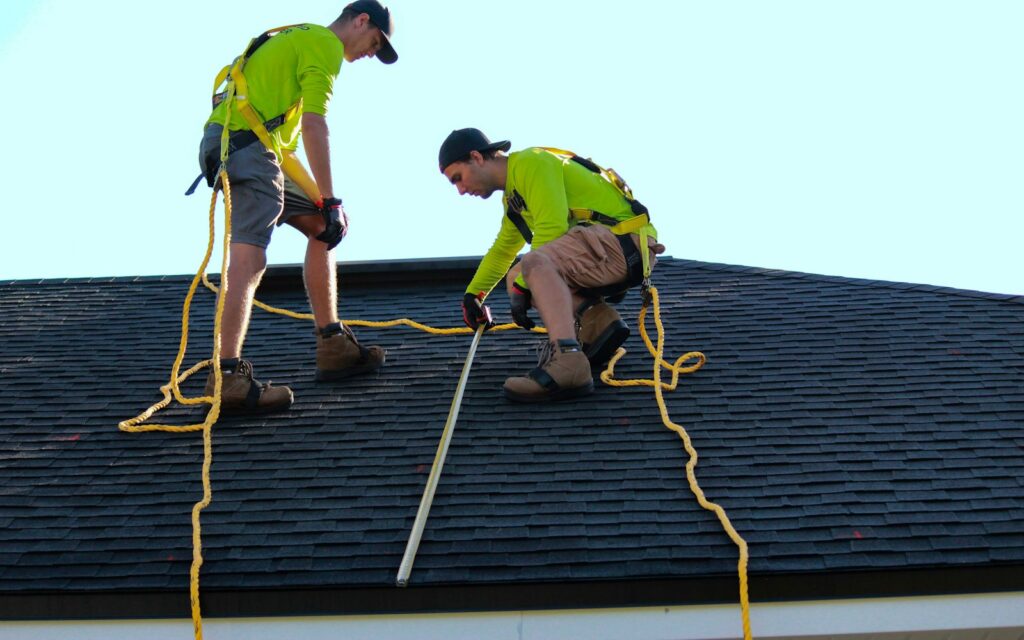
    A roof wet with sodium hypochlorite is slippery. If you or your crew go on the roof, use a roofer's fall protection kit (anchor, lifeline and harness) and check OSHA fall protection rules before you hire. Many roofs can be soft washed from a ladder or the ground with a 12V pump and the right nozzle; see our best soft wash system guide.

    Quote and book roof jobs faster

    Roof jobs are high-ticket, so a fast, professional quote matters. Field service apps like Jobber let you send line-item quotes with photos, follow up automatically and collect deposits online. Compare options in our best pressure washing software guide, and if you're building out your equipment, see the best soft wash system for roof work.

    Try Jobber free for 14 days

    Frequently asked questions

    How much does roof cleaning cost?

    Most homeowners pay $300–$1,050, with an average of about $600–$675 for a 1,500-square-foot roof. HomeGuide puts the national average at $440 across all roof sizes.

    How much does soft wash roof cleaning cost?

    Soft washing usually costs $0.30–$0.75 per square foot, according to This Old House and Fixr. HomeGuide lists a lower range of $0.15–$0.60.

    How much should I charge to clean a roof?

    Measure the roof area, start from a per-square-foot rate in the $0.30–$0.75 range for soft washing, add about $0.10 per square foot for each extra story and more for steep pitches, then make sure the total clears your minimum.

    Is roof cleaning worth it?

    Removing algae and moss improves curb appeal, and moss left in place can hold moisture against the roof. HomeGuide suggests cleaning every one to three years.

    Can you pressure wash a shingle roof?

    It's not recommended. The Asphalt Roofing Manufacturers Association advises against power washing asphalt shingles. Use a low-pressure soft wash instead.

    Is there a free roof cleaning cost calculator?

    Yes, the roof cleaning cost calculator above is free. It multiplies your roof footprint by a pitch factor, then applies a rate for the roof material and method, a stories adjustment and your minimum charge. Treat the result as a starting quote and adjust it for your market.

    Does a steep roof cost more to clean?

    Usually, yes. HomeGuide lists a steep-roof surcharge of about $0.15 to $0.20 per square foot. Steeper pitch also raises the true surface area, which the calculator handles with its pitch factor.

  • Best Pressure Washer Hose Reel (2026): Truck, Trailer and Retractable Picks

    Best Pressure Washer Hose Reel (2026): Truck, Trailer and Retractable Picks

    Disclosure: PowerWashPal may earn a commission if you buy through some links on this page, at no extra cost to you. As an Amazon Associate we earn from qualifying purchases. How we make money.

    Updated October 2026. Specs come from manufacturer listings, checked this month. We compare equipment through research, not hands-on testing. Here’s how we compare products.

    A good pressure washer hose reel pays for itself the first week. It stops kinks, keeps 100-plus feet of hose off the driveway and cuts minutes off every setup and teardown. The right reel depends on three things: the hose diameter you run, how much hose you need, and where the reel lives, on a wall, a truck bed or a trailer.

    Below are the pressure washer hose reels we’d shortlist for a cleaning business in 2026, from compact wall mounts to hand-crank reels built for trailers, plus a quick guide to picking capacity, pressure rating and retractable versus manual.

    Quick picks

    Best for Reel Capacity Rating
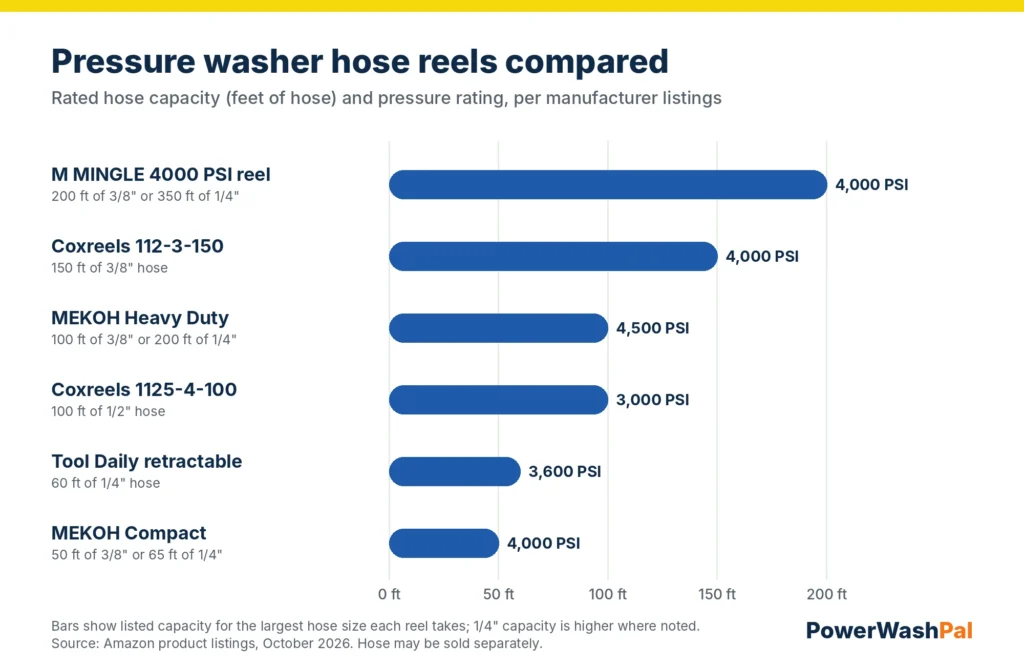
    Trucks and trailers (most hose) M MINGLE 4000 PSI reel 200 ft of 3/8″ or 350 ft of 1/4″ 4,000 PSI
    Pro hand crank Coxreels 112-3-150 150 ft of 3/8″ 4,000 PSI
    Highest pressure rating MEKOH Heavy Duty 100 ft of 3/8″ or 200 ft of 1/4″ 4,500 PSI
    Soft wash and supply hose Coxreels 1125-4-100 100 ft of 1/2″ 3,000 PSI
    Retractable (shop or garage) Tool Daily retractable reel 60 ft of 1/4″ 3,600 PSI
    Small spaces MEKOH Compact 50 ft of 3/8″ or 65 ft of 1/4″ 4,000 PSI
    Chart comparing pressure washer hose reels by hose capacity and PSI rating
    Listed hose capacity and pressure rating for each reel, October 2026.

    How to choose a pressure washer hose reel

    Match the hose diameter

    Most homeowner machines ship with 1/4-inch hose. Contractors usually run 3/8-inch hose because it carries more water with less pressure loss over long runs. Soft wash systems and water supply lines often use 1/2-inch hose. A reel’s capacity is always listed for a specific diameter, so 200 feet of 1/4-inch hose might only be 100 feet of 3/8-inch on the same reel.

    Buy more capacity than you think you need

    House washing from the driveway often means walking hose around the back of the home, so it’s common to need 150 feet of pressure hose or more. A reel that’s packed to the rim is hard to crank and wears the hose, so leave some room.

    Check the pressure rating

    The reel and its swivel need to be rated at or above your machine’s PSI. A 4,000 PSI reel covers almost every gas pressure washer used for residential work. Look for a solid brass or stainless swivel, since that’s the part that leaks first.

    Manual crank or retractable?

    Spring-driven retractable reels are convenient in a garage or wash bay, but they’re usually limited to shorter runs of 1/4-inch hose. Hand-crank reels handle heavier 3/8-inch hose and longer lengths, which is why most truck and trailer rigs use them.

    Plan the mount

    Wall-mount reels need a solid stud or masonry anchor. Truck and trailer reels should bolt through the bed or a skid plate, with the outlet facing the direction you’ll pull the hose. Steel and powder-coated frames are tough; stainless costs more but holds up better around chemicals and road salt.

    The best pressure washer hose reels

    M MINGLE 4000 PSI hose reel: best for trucks and trailers

    This reel is listed for up to 200 feet of 3/8-inch hose or 350 feet of 1/4-inch, rated at 4,000 PSI, one of the larger capacities you’ll find on Amazon. It’s a common choice for owners building their first trailer or truck setup. The hose is sold separately.

    • Good for: house washing crews that need a long hose run.
    • Watch out for: a full 200 feet of 3/8-inch hose is heavy, so mount it low and solid.

    Check price on Amazon

    Coxreels 112-3-150: best professional hand-crank reel

    Coxreels is a long-standing US reel maker, and the 112-3-150 is built for 150 feet of 3/8-inch hose at 4,000 PSI. It has an all-steel frame, a machined solid brass 90-degree swivel and an adjustable tension brake so the hose doesn’t free-spool. It has hundreds of Amazon reviews, more than most reels in this category.

    • Good for: daily commercial use where durability matters most.
    • Watch out for: costs more than import reels; hose not included.

    Check price on Amazon

    MEKOH Heavy Duty reel: highest pressure rating

    MEKOH’s heavy-duty reel is rated at 4,500 PSI and holds 100 feet of 3/8-inch or 200 feet of 1/4-inch hose. It has an adjustable tension brake and a design meant to avoid sharp bends where the hose connects.

    • Good for: high-PSI machines and tighter mounting spaces.
    • Watch out for: only 100 feet of 3/8-inch hose.

    Check price on Amazon

    Coxreels 1125-4-100: best for soft wash or supply hose

    This Coxreels model takes 100 feet of 1/2-inch hose at 3,000 PSI, with a welded steel A-frame, a brass swivel, a tension brake and sealed bearings. It’s made in the USA. Half-inch capacity makes it a good fit for a soft wash line or a water supply hose rather than a pressure line.

    • Good for: 12V soft wash rigs and water supply hose on a trailer.
    • Watch out for: lower PSI rating than the reels above.

    Check price on Amazon

    Tool Daily retractable reel: best retractable option

    If you want a self-rewinding pressure washer hose reel for a shop, garage or wash bay, Tool Daily’s retractable reel is listed for 60 feet of 1/4-inch hose at 3,600 PSI. It’s popular on Amazon, with hundreds of reviews.

    • Good for: fixed wash bays and owners who also use a smaller machine at the shop.
    • Watch out for: too short and too light for most mobile residential work.

    Check price on Amazon

    MEKOH Compact reel: best for small spaces

    The MEKOH Compact holds 50 feet of 3/8-inch or 65 feet of 1/4-inch hose at 4,000 PSI and mounts on any flat surface. It’s a good second reel for a whip line or a smaller trailer.

    • Good for: short whip hoses and tight spaces.
    • Watch out for: limited capacity for house washing.

    Check price on Amazon

    How we chose these reels

    We didn’t test these reels ourselves. We shortlisted reels sold on Amazon by established brands, then compared listed hose capacity, pressure rating, frame and swivel materials, brake design and how many verified buyers have reviewed each one. We left out reels without a clear pressure rating or capacity.

    Setting up your rig around the reel

    A reel is one piece of a working setup. For a full list of what goes on a truck or trailer, from the machine to surface cleaners and nozzles, see our pressure washing equipment list. If you’re adding soft washing, our best soft wash system guide covers pumps and 1/2-inch hose setups.

    Once your rig is ready, quoting fast matters as much as cleaning fast. Use our free pressure washing estimate calculator to price jobs on the spot.

    Building a full rig around your reels? See our pressure washer trailer setup guide for layout, water tank weight and plumbing order.

    Frequently asked questions

    What size hose reel do I need for a pressure washer?

    Match the reel to your hose diameter and length. Most contractors run 3/8-inch hose and want room for 150–200 feet, while homeowners with 1/4-inch hose can get by with 50–100 feet.

    Are retractable pressure washer hose reels worth it?

    They’re convenient for fixed locations like a garage or wash bay. For mobile work with long 3/8-inch hose, a hand-crank reel is usually more durable and holds more hose.

    Do pressure washer hose reels come with hose?

    Some do and many don’t. Pro reels like Coxreels are usually sold empty, so check each listing before you buy.

    What PSI rating should a hose reel have?

    At least as high as your pressure washer’s maximum PSI. A 4,000 PSI reel covers most residential gas machines.

    Can I use a pressure washer hose reel for soft washing?

    Yes, as long as it fits your soft wash hose, usually 1/2-inch, and the swivel and seals can handle the chemicals you use. Rinse the reel and swivel with fresh water after bleach jobs.

  • Best Soft Wash System (2026): Pumps, 12V Kits and Roof Setups

    Best Soft Wash System (2026): Pumps, 12V Kits and Roof Setups

    Disclosure: PowerWashPal may earn a commission if you buy through some links on this page, at no extra cost to you. As an Amazon Associate we earn from qualifying purchases. How we make money.

    Updated October 24, 2026. Specs come from manufacturer and retailer listings, checked this month. We compare equipment through research, not hands-on testing. Here’s how we compare products.

    The best soft wash system for your business depends on one question: are you washing houses, or are you cleaning roofs too? A soft wash system mixes cleaning solution and sprays it at low pressure, so the chemical does the work instead of high-pressure water. A house-wash setup can start with a cheap downstream injector. A roof soft wash system needs a dedicated pump with enough flow to reach the roof from the ground.

    This guide breaks down the four types of soft wash systems, the 12V soft wash pumps contractors actually build around, and what a complete kit costs, so you can buy once instead of twice.

    Quick picks

    Best for Pick Why
    Roof soft washing on 12V Remco Fatboy 7.0 GPM demand pump 7 GPM flow, Viton construction, demand or bypass mode
    Bleach-rated 12V pump Remco 5900 Series Smooth-Flo Bleach Pump Built for bleach, 7 GPM at up to 100 PSI
    House washing NorthStar 5.5 GPM soft wash pump Made for bleach and disinfectant, enough flow for siding
    Budget 12V build Everflo EF7000 7.0 GPM pump Low price, 7 GPM, huge review base (check chemical ratings)
    Cheapest way to start Downstream injector on your pressure washer Lowest-cost add-on, fine for house washes
    High-volume roofs and commercial Gas-powered diaphragm skid (10–12 GPM) Most reach and volume, sold through equipment dealers

    Soft wash pumps compared

    PumpFlowPressureBest for
    Remco Fatboy 7.0 GPM7 GPM—Roof soft washing on 12V
    Remco 5900 Smooth-Flo Bleach Pump7 GPMup to 100 PSIBleach-rated daily use
    NorthStar 5.5 GPM5.5 GPM—House washing
    Everflo EF70007 GPM60 PSIBudget 12V build
    Shurflo 20883 GPM45 PSISpot work only
    Gas skid (BE SW1165)11 GPM300 PSIHigh-volume roofs and commercial

    Prices change often — click through to Amazon or the dealer for the current price.

    What a soft wash system is (and what’s in one)

    Every soft wash system does the same job: it gets a measured mix of sodium hypochlorite (SH), surfactant and water onto a surface at low pressure, then lets it dwell and kill the mold, algae and mildew. A complete setup usually has six parts:

    • Chemical tanks: one for SH and water or a premix, sometimes a separate surfactant tank.
    • Pump: a 12V, 24V or gas-powered diaphragm pump. Pressure washers are not soft wash pumps, so most systems keep the two separate.
    • Mixing method: a premixed batch tank, a proportioner that meters chemical into the line, or a downstream injector.
    • Hose and reel: usually 1/2-inch hose, often 200 feet on a reel.
    • Gun and nozzles: a chemical-rated gun with nozzles sized to the pump’s flow.
    • Power: a deep-cycle battery and charger for 12V systems, or a small engine for gas units.

    Material matters more than brand names. Dultmeier, a pump and sprayer distributor, lists polypropylene, Viton, Santoprene and polyethylene as the materials best suited to sodium hypochlorite. Check that the pump housing, valves and seals use them before you buy.

    The four types of soft wash systems

    1. Downstream injection

    A downstream injector pulls chemical into the water line after your pressure washer’s pump, so bleach never touches the pump. It’s the cheapest way to start soft washing and works well for vinyl and metal siding. The catch is dilution: forum contractors note downstream injection can’t reach the stronger mixes roofs need, and reach depends on the nozzle you use.

    Check price on Amazon (General Pump downstream injector)

    2. X-Jet and M5-style nozzles

    An X-Jet or M5-style nozzle siphons chemical at the gun instead of the pump, from a bucket on the ground. Contractors use them to deliver stronger mixes than a standard downstream injector, and they can shoot higher. The trade-off is dragging a bucket and a second hose around the job.

    Check price on Amazon (M5-style twist nozzle, 3–7 GPM)

    3. 12V pump systems

    A 12V soft wash system is the most common dedicated setup for small companies. It’s a demand pump that runs only when you pull the trigger, powered by a deep-cycle battery. Dultmeier puts 12V pumps at about 7 GPM maximum flow, and says 5 GPM, 100 PSI pumps can reach 30 feet or more with the right nozzle and gun. They’re quiet, cheap to replace and need no oil or fuel. The downside is a shorter life than gas pumps, especially if a pressure switch keeps cycling.

    4. Gas-powered diaphragm systems

    Gas soft wash systems use a small engine, often a Honda GX200, to drive a diaphragm pump. Kleen-Rite lists BE Pressure soft wash units with Comet or CP diaphragm pumps at 11 GPM and 300 PSI. Dultmeier says gas systems can reach well past 50 feet with the right gun and nozzle. They’re the choice for big roofs, commercial buildings and crews with more than one sprayer, but they’re louder, cost more and need oil changes and diaphragm service.

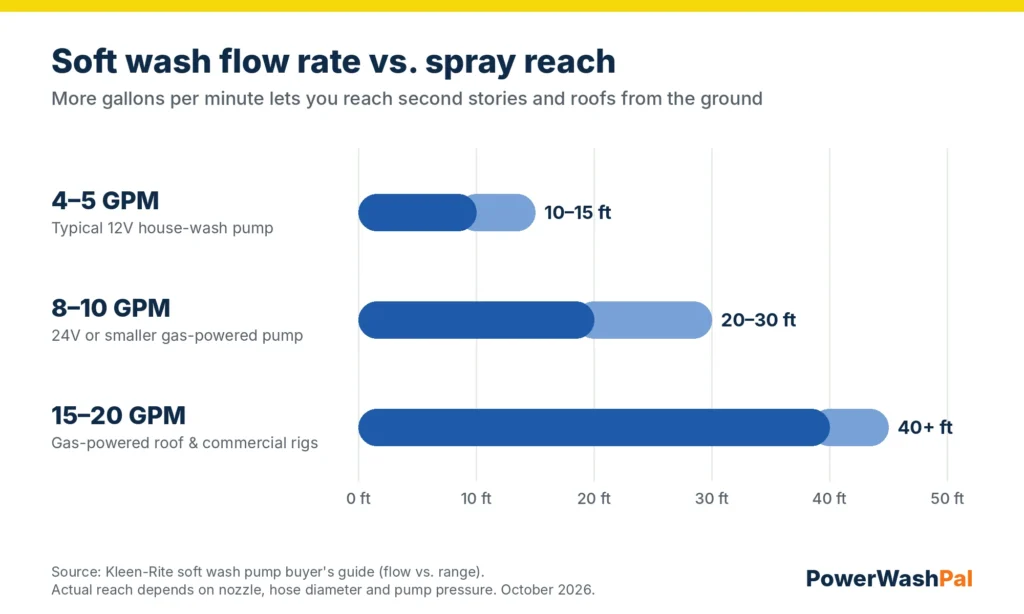
    Chart comparing soft wash system flow rate in GPM with spray reach in feet
    Higher flow means more reach. Source: Kleen-Rite soft wash pump buyer’s guide.

    How we chose these soft wash pumps

    We didn’t test these pumps ourselves. We compared published specs (flow, pressure, materials, operating mode), distributor buying guides from Kleen-Rite and Dultmeier, Sprayer Depot’s pump notes, and what working contractors report on PressureWashingResource. We only list Amazon products with clear model numbers from established pump makers, and we skip unbranded pumps.

    The best soft wash pumps and systems

    Remco Fatboy 7.0 GPM 12V demand pump: best 12V pump for roofs

    The Remco Fatboy (model 5538-1E1-94A) is a five-chamber diaphragm pump with Viton parts, rated at 7 GPM. It’s self-priming, can run dry and works in demand or bypass mode. That flow is about the most you’ll get from a 12V pump, which is what you want for second stories and low-pitch roofs.

    • Good for: roof and house soft washing from one 12V rig.
    • Watch out for: higher-flow 12V pumps draw more amps, so size your battery and wiring for it.

    Check price on Amazon

    Remco 5900 Series Smooth-Flo Bleach Pump: best bleach-rated pump

    Remco’s 5900 Series (model 5918-9I1-94A) is listed specifically as a bleach pump, rated at 7.0 GPM and up to 100 PSI with 1/2-inch ports. If you’ll run SH every day, a pump built for it is worth the extra cost. It’s a newer listing on Amazon with few reviews so far.

    • Good for: owners who want a pump designed around bleach from the start.
    • Watch out for: limited Amazon review history.

    Check price on Amazon

    NorthStar 5.5 GPM soft wash pump: best for house washing

    NorthStar sells this pump for soft washing and disinfecting with bleach-based solutions. At 5.5 GPM it sits right in the range most house washes need, and NorthStar is a brand many contractors already know from their pressure washers.

    • Good for: one- and two-story house washes.
    • Watch out for: less flow than 7 GPM pumps for roof work.

    Check price on Amazon

    Everflo EF7000 7.0 GPM pump: best budget 12V build

    The Everflo EF7000 is a 12V diaphragm pump rated at 7.0 GPM and 60 PSI, self-priming up to 12 feet, with polypropylene construction and hundreds of Amazon reviews. It’s marketed for agricultural chemicals, so confirm the seals suit sodium hypochlorite before you commit it to bleach work, and keep a spare on the truck.

    • Good for: a low-cost first 12V system or a backup pump.
    • Watch out for: not sold as a bleach-specific pump; lower pressure rating.

    Check price on Amazon

    Shurflo 2088: for spot work, not full houses

    The Shurflo 2088 (model 2088-343-435) is a reliable 12V pump, but at 3 GPM and 45 PSI it’s better for small spray rigs, spot treatments and window-cleaning carts than for whole houses or roofs.

    Check price on Amazon

    Gas-powered skids: best for high-volume roofs and commercial work

    For big roofs and commercial buildings, look at gas diaphragm units like BE Pressure’s SW1165 series (Honda GX200 engine, Comet or CP diaphragm pump, 11 GPM at 300 PSI per Kleen-Rite). These are sold through pressure washing equipment dealers rather than Amazon, and most dealers will also build a full skid with tanks and reels.

    What a complete soft wash kit costs

    If you’d rather buy a finished 12V system, prices give you a sense of the jump from parts to turnkey. In October 2026, CleanFreak listed a Remco 7 GPM, 100 PSI soft wash skid plate (pump, accumulator, switch and aluminum plate) at $1,495 and its complete system with a cage, proportioner, 200 feet of 1/2-inch hose on a stainless reel, a wand with four nozzles and a battery charger at $3,395. A battery wasn’t included.

    How to build a 12V roof soft wash system

    1. Pump: a 7 GPM 12V diaphragm pump with bleach-compatible materials.
    2. Battery: a deep-cycle marine battery (CleanFreak specifies a Group 24) plus a smart charger.
    3. Tank: a polyethylene tank sized to your typical job, or two tanks if you keep SH and surfactant separate.
    4. Mixing: premix in the tank for simplicity, or add a proportioner with metering valves to change ratios between jobs.
    5. Hose and reel: 1/2-inch soft wash hose, usually 200 feet, on a reel. A hose reel saves time on every job.
    6. Gun and nozzles: a chemical-rated gun and nozzles matched to your pump’s GPM.
    7. Skid or frame: bolt it all to a plate or cage so it moves as one unit.

    On chemical strength, contractors commonly report needing a much stronger SH mix on roofs than on siding. Always follow the chemical label and safety data sheet, wear eye and skin protection, and pre-wet plants. The Asphalt Roofing Manufacturers Association advises against power washing asphalt shingles, which is why roofs are soft washed. Our soft washing vs pressure washing guide covers when to use each method.

    12V vs gas soft wash system

      12V system Gas system
    Typical flow 5–7 GPM 10–12 GPM
    Reach About 30 ft with the right nozzle 50 ft or more
    Noise Quiet Loud
    Upkeep Charge the battery; replace pump when worn Oil, fuel, diaphragm service
    Up-front cost Lower Much higher
    Best for House washes, small roofs, solo operators Big roofs, commercial, multi-sprayer crews

    One more thing to weigh: Kleen-Rite notes California was the first state to move against small gas engines, and others may follow. If you work in a noise-sensitive or regulated area, a 12V or 24V system is the safer long-term bet.

    Pricing soft wash jobs once you’re set up

    Roof soft washing typically runs $0.30–$1.00 per square foot, and house washing $0.10–$0.50. Plug your measurements into our free pressure washing estimate calculator to get a quote in seconds, and read how much to charge for pressure washing for the full pricing playbook. When you’re ready to send quotes and schedule jobs from your phone, field service apps like Jobber handle quoting, scheduling and invoicing in one place.

    Try Jobber free for 14 days

    Related guides

    Fitting a soft wash system onto a trailer? Our pressure washer trailer setup guide covers layout, weight balance and plumbing.

    Frequently asked questions

    What is the best soft wash system for a beginner?

    If you already own a pressure washer, start with a downstream injector or an M5-style nozzle for house washes. Once you add roof cleaning, move to a 12V pump system with a 5–7 GPM bleach-compatible pump.

    What GPM do I need for a roof soft wash system?

    Kleen-Rite recommends 8–10 GPM for best results, which usually means a 24V or gas pump. Many owner-operators still clean one-story and low roofs with 7 GPM 12V pumps by matching the nozzle to the pump.

    Can I use a pressure washer for soft washing?

    Yes, with a downstream injector or X-Jet-style nozzle, which keep bleach out of the pump. It works for siding, but it can’t deliver the stronger mixes many contractors use on roofs.

    How much does a soft wash system cost?

    A downstream injector is the cheapest option. For dedicated systems, CleanFreak listed a Remco 12V skid plate at $1,495 and a complete 12V system at $3,395 in October 2026. Building your own from parts usually costs less, and gas-powered skids cost more.

    What pump material works with bleach?

    Look for polypropylene housings and Viton or Santoprene seals and diaphragms. Distributors list these as the best materials for sodium hypochlorite.

    What is a gas soft wash system?

    A gas soft wash system uses an engine-driven pump instead of a 12V electric one. Distributor figures put 12V pumps at roughly 5 to 7 GPM at most and gas diaphragm pumps at 10 to 12 GPM, so gas makes sense when you need more flow and reach for two-story houses and roofs. The gas BE SW1165 is sold through dealers.

    What tank and pump do I need for a soft wash system?

    A basic soft wash tank and pump setup pairs a polyethylene chemical tank sized to your typical job (or two tanks if you keep SH and surfactant separate) with a pump built for bleach: a polypropylene housing with Viton or Santoprene seals and diaphragms. Many owner-operators run 7 GPM 12V pumps on one-story and low roofs, while Kleen-Rite recommends 8–10 GPM (usually a 24V or gas pump) for best results.

    Should I choose 12V or 24V?

    12V pumps top out around 7 GPM. Kleen-Rite recommends 8–10 GPM for best roof results, which usually means a 24V or gas pump. If you mostly wash houses and low roofs, a 7 GPM 12V pump with the right nozzle is enough; for tall roofs and volume, step up.

    Can a 12V system reach a second-story roof?

    A 5 GPM, 100 PSI pump can reach 30 feet or more with the right nozzle and gun. Gas systems reach well past 50 feet. Match the nozzle to your pump’s flow.

    Do I need a proportioner, or is premixing enough?

    Premixing in the tank is simplest. A proportioner with metering valves lets you change ratios between jobs without re-mixing. Start premixed, and add a proportioner when you regularly run multiple mixes.

    How long will a 12V pump last on bleach?

    Shorter than a gas pump, especially if the pressure switch keeps cycling. Keep a spare on the truck, and make sure seals and diaphragms are Viton or Santoprene.

  • Pressure Washing Estimate Calculator (Free 2026 Pricing Tool)

    Pressure Washing Estimate Calculator (Free 2026 Pricing Tool)

    As an Amazon Associate I earn from qualifying purchases. Some of the links in this article are affiliate links — if you buy through them, we may earn a commission at no extra cost to you.

    Disclosure: PowerWashPal may earn a commission if you sign up through some links on this page, at no extra cost to you. It never changes how we rank or describe software. How we make money.

    Updated October 2026. Rates come from public US pricing guides (Angi, HomeAdvisor, Fixr, HomeGuide and Housecall Pro), checked this month.

    This free pressure washing estimate calculator turns a few measurements into a ready-to-send price. Pick the services, enter the square footage, choose where you want to sit in your local market, and you’ll get line items, a total and a market range in seconds. It works for house washing, driveways and patios, roof soft washing and commercial flatwork, and it applies your minimum charge so small jobs still pay.

    Use it as a starting point, not a final answer. Your costs, your area and how dirty the job is matter more than any national average, so we explain every number the calculator uses below.

    Pressure washing estimate calculator

    1. Choose services and enter square footage

    2. Set your pricing

    Estimated price
    $0
    Rates per sq ft: house $0.10 / $0.30 / $0.50, flatwork $0.20 / $0.30 / $0.40, roof $0.30 / $0.65 / $1.00, commercial $0.08 / $0.24 / $0.40 (budget / typical / premium). Story and condition adjustments are PowerWashPal suggestions; change them to fit your costs.

    Want to send this as a professional quote with a sign-off button instead of a text message? Field service apps like Jobber turn the same line items into an online quote your customer can approve from their phone. More on that below.

    The rates behind the calculator

    Every rate in the tool comes from the price ranges that major US cost guides publish for homeowners. Those are the numbers your customers see when they Google a price, so they’re a fair anchor for your quotes.

    ServiceBudgetTypicalPremiumTypical job
    House washing$0.10/sq ft$0.30/sq ft$0.50/sq ft$250–$800
    Driveways, sidewalks & patios$0.20/sq ft$0.30/sq ft$0.40/sq ft$100–$300 (driveway)
    Roof soft washing$0.30/sq ft$0.65/sq ft$1.00/sq ft$350–$750
    Commercial flatwork$0.08/sq ft$0.24/sq ft$0.40/sq ft$500–$1,000 (5,000 sq ft lot)

    “Budget” and “premium” are the low and high ends of each published range. “Typical” is the middle. If you’re new, have little review history or work in a lower-cost area, start near the middle and move up as your calendar fills. Most companies also charge by the hour for odd jobs, usually $50–$150 an hour for residential work and $100–$200 for commercial.

    Pressure washing rates per square foot
    Typical US pressure washing rates per square foot, October 2026.

    How to measure a job in five minutes

    Good estimates start with good square footage. You don’t need to visit every home to get close.

    • House washing: use the home’s living area from the listing or county property records, then pick the number of stories in the calculator. Walk the property before you start work and adjust if there are big additions, detached garages or lots of trim.
    • Driveways and patios: multiply length by width for each slab and add them up. Satellite measuring tools in Google Maps or Google Earth are accurate enough for a quote.
    • Roofs: use roof area, not the home’s footprint. Steep pitches and multiple stories take longer, so lean toward the premium rate or add a condition adjustment.
    • Commercial lots: measure the parking area, walkways and dumpster pads separately. Commercial clients often ask for a per-visit price on a monthly or quarterly schedule.

    On site, a laser measure or a measuring wheel makes walk-arounds fast and keeps your numbers honest on long fences, gutters and storefronts.

    Adjustments to make before you send a price

    The calculator handles the common adjustments. Here’s how to think about each one.

    Condition

    Heavy mold, oil stains, rust or years of buildup mean more chemical, more dwell time and more passes. The tool adds 15% for normal buildup and 30% for heavy jobs. Those percentages are our suggestion, not an industry rule, so change them if your costs say otherwise.

    Stories and access

    A two-story home needs ladders or extension wands and simply takes longer. The calculator adds 15% for two stories and 30% for three. Tight side yards, landscaping you have to protect and no nearby water spigot are also good reasons to price higher.

    Minimum job charge

    Most companies set a minimum of $100–$250 so a small patio still covers drive time, setup and chemicals. The calculator applies your minimum automatically whenever the job total comes in lower.

    Recurring discounts

    Recurring contracts usually run 15–30% below one-time pricing, because the surfaces stay cleaner and you get guaranteed work. Use the discount menu when you quote a monthly, quarterly or yearly plan.

    For a deeper look at pricing strategy, read our full guide on how much to charge for pressure washing.

    What to include in a pressure washing estimate template

    The “Copy estimate text” button gives you a simple version you can paste into a text or email. A complete written estimate should also cover:

    1. Your business details: company name, phone, email and license or insurance info if your state or customer requires it.
    2. Customer and property: name, service address and the date of the estimate.
    3. Line items: each surface with its square footage and price, so the customer can drop or add items.
    4. Method: pressure washing or soft washing for each surface, plus any chemicals used near plants.
    5. What’s not included: rust or oil stain removal, sealing, gutter interiors or anything else you charge extra for.
    6. Terms: how long the price is valid (30 days is common), payment terms, deposit, weather rescheduling and what happens if there’s no working water on site.
    7. Approval: a signature line or an “Approve” button if you use software.

    If you also want a signed agreement for bigger or recurring jobs, add a short service contract with insurance and liability terms. Our pressure washing business insurance guide explains the coverage most customers and property managers ask for.

    From estimate to booked job: let software do the follow-up

    A calculator gets you a price. Getting paid depends on how fast the quote reaches the customer and whether anyone follows up. That’s where field service software earns its monthly fee.

    • Jobber lets you build quotes from saved line items, send them by text or email and collect approval online. Automatic quote follow-ups start on the Connect plan ($99 a month billed annually or $139 monthly), and optional line items and photos on quotes are part of Grow ($149 annually or $199 monthly). There’s a 14-day free trial with no card required.
    • Housecall Pro also sends online estimates customers can approve, starting with the Basic plan at $59 a month billed annually or $79 monthly. It’s available in the US and Canada only.

    Compare the two side by side in our Jobber vs Housecall Pro comparison, or see current plan prices in our Jobber pricing breakdown.

    Try Jobber free for 14 days Try Housecall Pro free

    Ready to book the job? Put it in writing with our free pressure washing contract template (Word and PDF).

    Frequently asked questions

    How do you estimate a pressure washing job?

    Measure the square footage of each surface, multiply by a per-square-foot rate for that service, then adjust for condition, height and access. Add a trip fee if you travel far and make sure the total clears your minimum job charge. The calculator above does all of this in one step.

    How much does pressure washing cost per square foot?

    Typical US rates run about $0.10–$0.50 per square foot for house washing, $0.20–$0.40 for driveways and patios, $0.30–$1.00 for roof soft washing and $0.08–$0.40 for commercial flatwork.

    How much should I charge to pressure wash a driveway?

    Most companies charge $100–$300 for a standard driveway, or $0.20–$0.40 per square foot. Enter the driveway’s square footage in the calculator to get a price for your market position. For a driveway-only price, try our driveway pressure washing cost calculator.

    What should a minimum charge be for pressure washing?

    Most companies set a minimum between $100 and $250. Base yours on what one trip really costs you: drive time, setup, chemicals and wear on your equipment.

    Is this pressure washing cost calculator accurate for my area?

    It uses national price ranges, so treat the result as a starting point. Check a few local competitors and your own costs, then use the budget, typical or premium setting that matches your market.

    Is this a free pressure washing estimate tool?

    Yes. The calculator is free and needs no sign-up. It is built for contractors who need a fast, consistent quote, but homeowners can use it for a ballpark too. Real quotes still depend on the surface, access and local rates.

    Where can I get a contract to send with the estimate?

    Use our free pressure washing contract template. It pairs with the estimate so the customer approves the scope and price in writing.

  • Pressure Washing Business Insurance: What You Need and What It Costs (2026)

    Pressure Washing Business Insurance: What You Need and What It Costs (2026)

    Disclosure: PowerWashPal may earn a commission if you buy through links on this page, at no extra cost to you. We don’t sell insurance and this isn’t legal or insurance advice. Read how we make money.

    Updated October 2026.

    Pressure washing looks low-risk until it isn’t. A 3,000 PSI wand can strip paint off a vintage car, blow out a window seal or etch a brand-new stamped patio. Soft wash chemicals can kill a homeowner’s prize hydrangeas. And a slip on a wet roof can end a season. Insurance is what turns those bad days into an annoying phone call instead of the end of your business.

    Whether you call it pressure washer insurance, insurance for a pressure washing business or a commercial policy for your pressure washing company, the coverage works the same way. Here’s what pressure washing business insurance actually costs in 2026, which policies you need at each stage, and the few questions to ask before you buy.

    How much does pressure washing insurance cost?

    According to Insureon, which reports median premiums from pressure washing businesses that applied for quotes through its platform, general liability insurance runs about $73 a month ($879 a year). That’s for a standard policy with $1 million per occurrence and $2 million aggregate limits and a $500 deductible.

    Bar chart of median monthly insurance costs for pressure washing businesses: commercial auto $262, workers comp $147, BOP $142, umbrella $76, general liability $73, janitorial bond $9
    Median monthly premiums by policy type. Source: Insureon.
    Policy Median monthly Median yearly Who needs it
    General liability $73 $879 Everyone, from day one
    Business owner’s policy (BOP) $142 $1,699 Owners with a shop, storage or pricey gear
    Commercial auto $262 $3,143 Any truck or van titled to the business
    Workers’ compensation $147 $1,761 As soon as you hire (required in most states)
    Commercial umbrella $76 $906 Commercial contracts that require higher limits
    Janitorial bond $9 $112 Crews working inside or around customers’ property unsupervised
    Source: Insureon median premiums for pressure washing customers, accessed October 2026. Your quote will vary.

    A separate 2026 study from MoneyGeek, based on modeled quotes, found general liability for pressure washers ranges from roughly $39 to $103 a month depending on the state. Location, payroll, claims history and whether you do commercial or roof work all move the number.

    Two workers on an asphalt shingle roof using safety ropes

    Insurance for a pressure washing business: the policies, in plain English

    General liability: the one you can’t skip

    General liability pays when you damage a customer’s property or someone gets hurt because of your work. Think: you lift a shingle with too much pressure and it leaks, or a neighbor slips on your hose line. Most HOAs, property managers and commercial clients will ask for a certificate of insurance (COI) before you set foot on site, so you’ll want this before your first paid job.

    Ask about this: some general liability policies exclude damage from chemicals or “pollution.” If you soft wash with sodium hypochlorite, ask the agent directly whether plant and paint damage from runoff is covered, or whether you need contractors’ pollution liability.

    Business owner’s policy (BOP)

    A BOP bundles general liability with commercial property coverage, usually at a better price than buying them separately. It makes sense once you have a garage, storage unit or shop full of equipment.

    Inland marine (tools and equipment)

    A skid unit, hot water machine and surface cleaner can easily top $10,000, and a standard property policy may not cover gear while it’s on your trailer or at a job site. Inland marine coverage follows the equipment. If you’ve built a rig like the one in our pressure washing equipment list, price this out.

    Commercial auto

    Your personal auto policy may deny a claim if the truck was being used for business, especially while towing a trailer full of water and chemicals. Commercial auto is the most expensive line for most washers, but it’s also the one that protects you from the biggest losses.

    Workers’ compensation

    Once you hire your first helper, most states require workers’ comp. Wet roofs, ladders and slick concrete make injuries common in this trade. Rules vary by state, so check with your state’s labor department.

    Umbrella

    An umbrella adds an extra $1 million (or more) on top of your liability and auto policies. You’ll usually only need it when a commercial client’s contract asks for higher limits.

    What to budget as you grow

    Bar chart of modeled pressure washing insurance bundles: BOP $74, plus commercial auto $269, plus workers comp $371, plus cyber and pollution $505 per month
    Modeled monthly premiums for common coverage bundles. Source: MoneyGeek, September 2026.
    • Solo, using a personal truck: general liability (around $73/mo median) plus a business-use endorsement on your auto policy.
    • Solo, business truck and trailer: BOP or GL, commercial auto and inland marine. MoneyGeek’s modeled bundle is about $269 a month.
    • Small crew: add workers’ comp. MoneyGeek’s modeled bundle is about $371 a month.
    • Commercial accounts: add pollution liability, cyber (if you store customer card data) and an umbrella. Around $505 a month in MoneyGeek’s model.

    Build insurance into your prices. If you’re spending $3,000 a year on coverage and doing 300 jobs, that’s $10 a job. Our pressure washing pricing guide shows how to fold overhead like this into your minimum charge.

    White enclosed trailer of the kind used to haul pressure washing equipment

    How to lower your premium

    1. Bundle into a BOP instead of buying general liability and property separately.
    2. Pick a higher deductible if you can cover small claims yourself.
    3. Pay annually. Many carriers charge installment fees on monthly payments.
    4. Document every job. Before-and-after photos and signed work orders help you fight bogus claims, which keeps your claims history clean. Field service apps like Housecall Pro and Jobber attach photos to each job automatically.
    5. Get three quotes. Compare an online marketplace with a local independent agent who writes contractor policies.

    Questions to ask before you buy

    • Is chemical runoff or overspray (plants, paint, cars) covered, or excluded as pollution?
    • Is roof work excluded, or does it raise the premium?
    • Are my tools covered on the trailer and at job sites?
    • How fast can you issue a certificate of insurance, and can I add a client as “additional insured” myself?
    • Does my policy cover subcontractors, or do they need their own?

    Just getting set up? Insurance is one of the first things we cover in our guide on how to start a pressure washing business.

    Getting set up? Grab our free pressure washing business plan template (Word + Excel financials) and the pressure washing contract template your customers sign before you start.

    FAQ

    Where can I find cheap pressure washing insurance?

    Get at least three quotes: one or two from online marketplaces and one from a local independent agent who writes policies for contractors. Then use the tricks above: bundle into a BOP, pay annually and take a higher deductible. Just don’t save money by dropping coverage for chemical overspray or property damage. That’s the claim exterior cleaners actually file.

    Do I need insurance to start a pressure washing business?

    Legal requirements depend on your state and city, but most clients, HOAs and property managers will ask for proof of it, and one damage claim can cost far more than a year of premiums. Treat it as required.

    How much is general liability insurance for pressure washing?

    About $73 a month ($879 a year) at the median, according to Insureon, for $1 million/$2 million limits. MoneyGeek’s 2026 study puts the state-by-state range at roughly $39 to $103 a month.

    Does general liability cover damage from soft wash chemicals?

    Not always. Some policies exclude pollution-related damage. Ask your agent, and consider contractors’ pollution liability if you soft wash. Our soft wash system guide covers bleach-safe pumps and low-pressure setups.

    Do I need workers’ comp if I’m the only employee?

    In most states, sole proprietors aren’t required to cover themselves, but rules vary. You’ll almost always need it once you hire.

    Does my personal auto insurance cover my work truck?

    Often not for business use. Talk to your carrier about a business-use endorsement or a commercial auto policy.

    Sources: Insureon, pressure washing insurance cost (accessed October 2026); MoneyGeek, pressure washing business insurance cost (September 2026). Figures are estimates and medians, not quotes. Requirements vary by state; this article isn’t legal or insurance advice.

  • How to Get Pressure Washing Customers: 11 Marketing Ideas That Work in 2026

    How to Get Pressure Washing Customers: 11 Marketing Ideas That Work in 2026

    Disclosure: PowerWashPal may earn a commission if you buy through links on this page, at no extra cost to you. We don’t accept payment for rankings. Read how we make money.

    Updated October 2026.

    You’ve got the rig, the insurance and a price sheet. Now the phone needs to ring. The good news: pressure washing is one of the most visual services there is. A clean stripe down a dirty driveway sells itself, and most of the best ways to find customers cost very little.

    Below are 11 pressure washing marketing ideas, roughly in the order we’d use them to market a pressure washing business if we were starting over this week. The first five are free, and together they generate more leads than most paid lead generation services.

    1. Set up your Google Business Profile before anything else

    When a homeowner searches “pressure washing near me,” the map results show up before any website. Your Google Business Profile is free and it’s how you get into that map. Fill out every field: service area, hours, services (house washing, driveway cleaning, roof soft washing, window cleaning), and at least 10 real before-and-after photos.

    Pick “Pressure washing service” as your primary category and add related ones you actually offer. Post a new before-and-after every week during your busy season.

    2. Make reviews a habit, not an afterthought

    Reviews are the single biggest lever for a local service business. BrightLocal surveyed 1,002 US adults in February 2026, and the numbers are hard to ignore:

    Bar chart from BrightLocal 2026: 85% more likely to hire after positive reviews, 77% put off by negative reviews, 74% want recent reviews, 80% prefer businesses that reply, 31% only hire 4.5 stars or higher
    How US consumers use reviews when choosing a local business. Source: BrightLocal, 2026.

    Notice two things. First, 74% want reviews from the last three months, so a pile of old reviews isn’t enough. Second, 80% prefer businesses that reply to every review. Ask every happy customer before you leave the driveway, send a text link the same day, and reply to each review by name.

    Software makes this automatic. Housecall Pro sends review requests on every plan, and Jobber offers it through its Marketing Suite add-on.

    3. Turn every job into a billboard

    Pressure washing is loud, visible and satisfying to watch. Neighbors will come over. Have a stack of business cards or door hangers in the truck, and leave a door hanger on the five houses on each side of the job: “We just cleaned your neighbor’s driveway at #123. Book this week and get 10% off.”

    Ask the homeowner if you can put a small yard sign out for a few days.

    Worker in a safety vest washing a sidewalk with a high-pressure hose

    4. Film short before-and-after videos

    A 15-second clip of a surface cleaner revealing clean concrete is the kind of thing people stop scrolling for. Post it to Facebook, Instagram Reels, TikTok and YouTube Shorts, and to your Google Business Profile. Tag the city in the caption (“Driveway cleaning in Plano, TX”). You don’t need a big following; local reach is what matters.

    5. Show up in local Facebook groups and Nextdoor

    Most towns have a “Moms of [City]” or “[City] Community” group where people ask for recommendations every week. Don’t spam. Answer questions, share a useful tip (“never pressure wash asphalt shingles, here’s why”), and let the regulars tag you. Nextdoor also has a free business page.

    6. Mail postcards with EDDM

    USPS Every Door Direct Mail lets you send postcards to every address on a mail carrier’s route without buying a mailing list. As of July 12, 2026, the retail EDDM postage rate is $0.260 per piece, with a minimum of 200 pieces and up to 5,000 per ZIP code per day.

    Households Postage at $0.26 Tip
    500 $130 Test one neighborhood near your best customers
    1,000 $260 Pick routes with older homes and big driveways
    2,500 $650 Mail in early spring, when people see winter grime
    Postage only; printing is extra. Rate source: USPS EDDM retail rate effective July 12, 2026.

    Use the USPS EDDM map tool to pick routes by household income and home age. Put a strong before-and-after photo on the front and a single, clear offer on the back.

    Gutter cleaning is one of the easiest bundles to sell with a house wash. Price it with our gutter cleaning cost calculator.

    Window cleaning is one of the easiest bundles to sell next to a house wash. See what to charge for window cleaning before you add it to your quotes.

    7. Bundle services to raise every ticket

    Getting a new customer is the expensive part. Once you’re there, offer the patio, walkway, gutters and fence too. A $200 driveway can become a $600 visit. Quotes with optional line items, which Jobber offers on its Grow plan, let customers tick add-ons themselves. See our Jobber pricing guide for which plan includes what.

    8. Follow up on every quote

    Homeowners often get two or three bids and then forget about them. A friendly text two or three days later (“Still want that house wash before your graduation party?”) wins a surprising number of jobs. Do it by hand at first, then let software automate it. Both tools in our Jobber vs Housecall Pro comparison can do this.

    Worker pressure washing a gas station forecourt at night

    9. Go after recurring commercial work

    Residential jobs pay well, but commercial accounts pay every month. Restaurants need dumpster pads and drive-thrus cleaned. Gas stations need pump islands degreased. Property managers need sidewalks, breezeways and building washes. Walk in with a one-page sheet, your certificate of insurance and a photo portfolio. (Commercial clients will ask for proof of coverage, so read our pressure washing insurance guide first.)

    10. Build a referral network

    Realtors need houses cleaned before listing photos. Painters need surfaces washed before they paint. Roofers, landscapers and window cleaners all meet your customers first. Offer a simple referral thank-you, like a gift card for every booked job, and keep a few of these partners busy with referrals in return.

    11. Make it easy to book

    All the marketing in the world is wasted if someone has to call three times to get a quote. Add online booking to your website and Google profile, answer texts fast, and send quotes the same day. If you’re still setting up, our guide on how to start a pressure washing business walks through the basics, and our best pressure washing software roundup compares booking tools.

    Infographic: 11 pressure washing marketing ideas to get customers, first five free

    Which pressure washing marketing ideas to start with

    Idea Cost Speed Best for
    Google Business Profile Free Weeks Everyone
    Review requests Free to low Ongoing Everyone
    Door hangers by each job Low Days New businesses
    Short videos Free Weeks Owners comfortable on camera
    Facebook groups and Nextdoor Free Days Suburban areas
    EDDM postcards $0.26 per home + printing 1 to 3 weeks Targeting specific neighborhoods
    Commercial accounts Your time Months Year-round revenue
    Referral partners Per-job thank-you Months Established businesses

    Before you spend on ads, make sure your prices hold up. Our pressure washing price guide has 2026 rates by surface.

    To price a specific job in seconds, use our free pressure washing estimate calculator.

    Getting set up? Grab our free pressure washing business plan template (Word + Excel financials) and the pressure washing contract template your customers sign before you start.

    FAQ

    What is the fastest way to get pressure washing customers?

    Door hangers around every job you do and posts in local Facebook groups usually bring the first calls within days. A complete Google Business Profile with reviews builds steadier leads over the following weeks.

    Should I hire a pressure washing marketing agency?

    Not in year one. Agencies that focus on pressure washing often charge a monthly retainer plus your ad spend, and most of what they do in the beginning (Google Business Profile, reviews, a simple website) you can set up yourself in a weekend. Bring one in once you have steady jobs and want to scale paid ads, and ask for real client results before you sign anything.

    How do I market a pressure washing business on a tight budget?

    Start with the free stuff in this order: Google Business Profile, a review request after every job, before-and-after photos on Facebook and Nextdoor, and a yard sign at every house you clean. Then put your first marketing dollars into door hangers around the homes you’ve already done.

    Do pressure washing flyers work?

    They can, if they’re targeted. Flyers and door hangers near a job you just finished work best, because neighbors can see the result. Put a before-and-after photo front and center.

    How much does EDDM cost for a pressure washing business?

    Retail EDDM postage is $0.260 per piece as of July 12, 2026, so 1,000 postcards cost $260 in postage plus printing.

    Should I buy pressure washing leads from Angi or Thumbtack?

    They can fill gaps when you’re new, but you pay per lead and compete with other bidders. Most owners do better long term building their own Google reviews and repeat customers.

    How do I get commercial pressure washing leads and contracts?

    Start local: visit restaurants, gas stations and property managers with a one-page service sheet, proof of insurance and photos of similar work. Offer a recurring schedule instead of a one-time price.

    Sources: BrightLocal Local Consumer Review Survey 2026 (1,002 US adults, February 2026); USPS Every Door Direct Mail, retail rate $0.260 per piece effective July 12, 2026.