Disclosure: PowerWashPal may earn a commission if you sign up through some links on this page, at no extra cost to you. How we make money.
Updated October 2026.
Soft washing and pressure washing both get surfaces clean, but they work in opposite ways. Pressure washing blasts dirt off with force. Soft washing kills and loosens the grime with cleaning solutions, then rinses it away gently. Using the wrong one can strip granules off a roof, force water behind vinyl siding, or gouge a cedar deck.
Here’s how the two methods differ, which surfaces need which, and what that means if you run (or are starting) an exterior cleaning business.
The quick answer
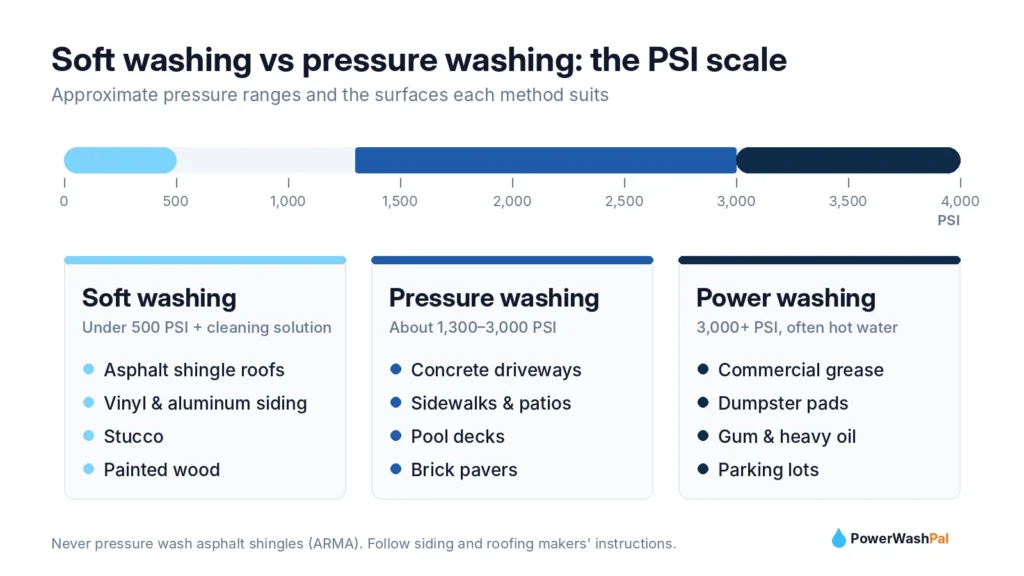
- Pressure washing uses high-pressure water, usually 1,300–3,000 PSI, to clean hard surfaces like concrete driveways, sidewalks, and patios.
- Soft washing uses low pressure, generally under 500 PSI, plus cleaning solutions to clean delicate surfaces like roofs, vinyl siding, stucco, and painted wood.
- Roofs should never be pressure washed. The Asphalt Roofing Manufacturers Association says high-pressure systems are likely to damage asphalt roofing.
What is pressure washing?
Pressure washing uses a gas or electric pump to push water out of a narrow nozzle at high pressure, typically 1,300–3,000 PSI. “Power washing” is often used to mean the same thing, though some pros reserve the term for heated water above 3,000 PSI. The force strips away dirt, oil, gum, and grime that’s bonded to hard surfaces.
Best for: concrete driveways, sidewalks, pool decks, patios, curbs, dumpster pads, and commercial flatwork. Most pros pair the wand with a surface cleaner, a spinning-bar attachment that cleans flat concrete evenly without stripes.
What is soft washing?
Soft washing applies a cleaning solution at low pressure, lets it dwell for a few minutes, then rinses at low pressure. The solution does the work: it kills the mold, mildew, and algae that cause green and black staining, instead of just knocking off the surface layer.
Best for: asphalt shingle roofs, vinyl and aluminum siding, stucco, painted wood, and other surfaces that high pressure can damage.
Soft washing vs pressure washing at a glance
| Pressure washing | Soft washing | |
|---|---|---|
| Pressure | About 1,300–3,000 PSI | Generally under 500 PSI |
| What cleans | Water force | Cleaning solution, then a gentle rinse |
| Best surfaces | Concrete, brick pavers, sidewalks | Roofs, vinyl siding, stucco, painted wood |
| Kills mold and algae | No, removes it from the surface | Yes, which is why results last longer |
| Main risk | Etching, gouging, water intrusion | Chemical runoff onto plants |
| Typical equipment | Gas pressure washer, surface cleaner | 12V pump or downstream injector, X-Jet, chemical-rated hose |
Which surfaces need which method
| Surface | Method | Why |
|---|---|---|
| Concrete driveway, sidewalk | Pressure wash | Hard surface; needs force for oil and grime |
| Asphalt shingle roof | Soft wash | High pressure knocks off protective granules |
| Vinyl siding | Soft wash | Pressure can drive water behind panels |
| Stucco | Soft wash | Porous and easy to chip |
| Wood deck | Low pressure, or soft wash | High pressure gouges soft woods like cedar |
| Brick | Low pressure with care | Old mortar can wash out |
Vinyl siding: the Polymeric Exterior Products Association (formerly the Vinyl Siding Institute) advises following both the siding and the washer maker’s instructions, keeping the spray at eye level, and never aiming upward, which pushes water behind the panels. Source.
Decks: Decks.com suggests starting around 1,800 PSI and warns that going much higher can strip stain and damage wood fibers. Source.
Why roofs must be soft washed
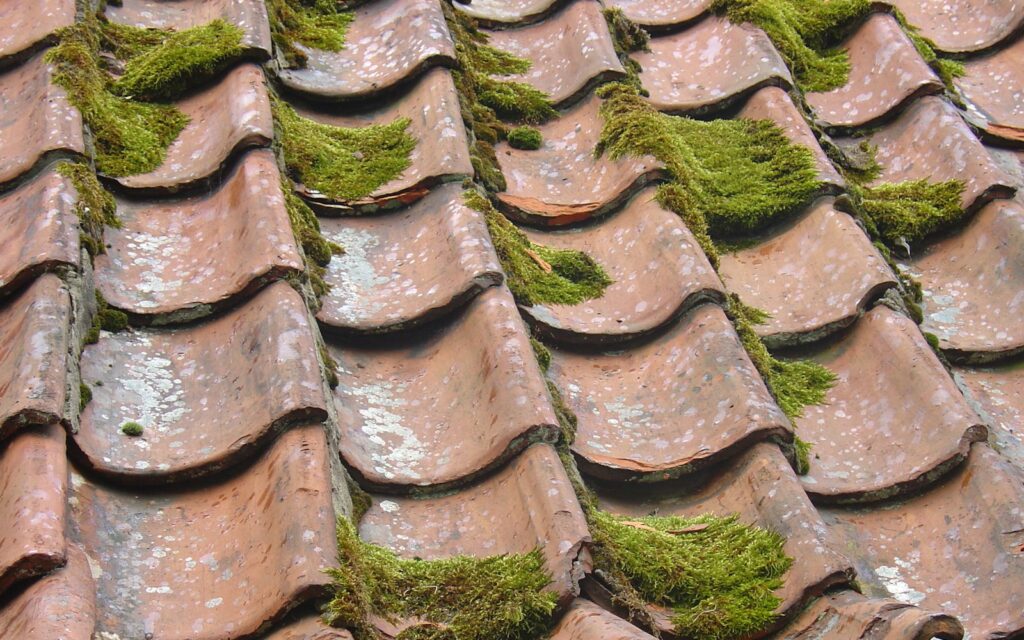
Those black streaks on roofs aren’t dirt. They’re mostly Gloeocapsa magma, an airborne blue-green algae that forms a dark protective coating against UV light. Pressure won’t kill it, and it will damage the roof.
The Asphalt Roofing Manufacturers Association warns not to use a power washer or any type of brush on shingles, and recommends a diluted bleach (sodium hypochlorite) and water solution followed by a gentle rinse. Owens Corning gives similar guidance, noting that high-pressure equipment loosens granules and shortens roof life. If a homeowner’s roof is under warranty, they should check the manufacturer’s cleaning instructions before any work.
Soft wash chemicals and safety
Most soft wash mixes are built on sodium hypochlorite (the active ingredient in bleach) plus a surfactant that helps the mix cling to walls and slows drying. Trade sources commonly describe weaker mixes for siding (around 1% at the surface) and stronger mixes for roofs (around 3–6%, depending on growth). Always follow the product label and safety data sheet for anything you use.
Safety basics every crew should follow:
- Never mix sodium hypochlorite with acids or ammonia. Both combinations release toxic gas.
- Wear PPE: goggles or a face shield, chemical-resistant gloves and boots, and appropriate protective clothing.
- Protect plants: soak landscaping with water before and after application.
- Control runoff: sodium hypochlorite is very toxic to aquatic life, so keep it out of storm drains and check local rules.
- Watch painted surfaces: strong mixes can fade some paints and trim.
How long do results last?
Because soft washing kills the organisms instead of just removing the stain, results usually last longer. Some industry sources estimate a soft-washed roof stays clean for 2–5 years, while ARMA notes that algae will likely return eventually. That makes roof and house washing ideal recurring services: a reminder every 1–3 years brings customers back without new advertising.
Cost: soft washing vs pressure washing
- House soft wash: about $300–$850, or $0.25–$0.50 per square foot.
- Roof soft wash: about $350–$750, or $0.30–$1.00 per square foot.
- Driveway pressure wash: about $100–$300.
See our full 2026 pressure washing price guide for per-square-foot rates by surface and city.
Running both services in your business
Most successful exterior cleaning companies offer both: pressure washing for flatwork and soft washing for houses and roofs. Bundling them raises your average ticket. A homeowner who books a driveway is a natural fit for a house wash, and a house wash customer often needs the roof done too.
Field service software makes the bundle easy to sell and easy to repeat:
- Quotes with options. Jobber quotes can show optional add-ons like “roof soft wash” or “gutter brightening” that customers tick to approve (Grow plan).
- Separate price book items for soft wash and pressure wash services, so every tech quotes the same way.
- Recurring reminders. Schedule yearly house washes or roof checks so past customers come back on their own. Housecall Pro’s Max plan adds recurring service plans.
- Before-and-after photos attached to jobs and invoices, which help justify soft wash pricing.
- Review requests. Housecall Pro sends them after every job, and roof transformations get great reviews.
Try Jobber free for 14 days Try Housecall Pro free
Just getting started? Read our step-by-step guide on how to start a pressure washing business, then compare tools in our Jobber review.
Frequently asked questions
Is soft washing better than pressure washing?
Neither is better overall. Soft washing is better for roofs, siding, and stucco, while pressure washing is better for concrete and other hard surfaces.
Can you pressure wash a roof?
You shouldn’t pressure wash asphalt shingles. ARMA and Owens Corning both warn that high pressure damages shingles and loosens granules. Soft washing is the recommended method.
What PSI is soft washing?
Soft washing generally uses under 500 PSI, often closer to garden-hose pressure. The cleaning solution does most of the work.
Does soft washing kill mold?
Yes. The sodium hypochlorite in soft wash solutions kills mold, mildew, and algae, which is why results last longer than pressure washing alone.
Is soft washing safe for plants?
It can be when done properly. Pros wet plants before and after application, control runoff, and use the weakest mix that gets the job done.