Disclosure: PowerWashPal may earn a commission if you buy through links on this page, at no extra cost to you. This is general information, not financial or legal advice. Read how we make money.
Updated October 2026.
A pressure washing business plan doesn’t need to be 40 pages. If you’re funding the start from savings, five pages that answer a few questions are enough: what you’ll sell, to whom, at what price, how customers will find you, what it costs to start and how many jobs you need to make it worth it. If you’re asking a bank or the SBA for a loan, you’ll need the same plan with more detail in the market and financial sections.
We built a free power washing business plan template for both cases. It’s a Word document with a guiding note and a worked example in every section, plus an Excel spreadsheet that calculates your startup costs, a 12-month projection and your break-even point. Download them below, then use this guide to fill them in.
Free pressure washing business plan template
9-section plan (Word or PDF) + financial spreadsheet with startup costs, 12-month projection and break-even. No email required.
What goes in a pressure washing business plan
Our template follows the traditional structure the U.S. Small Business Administration recommends, adapted for an exterior cleaning company:
- Executive summary: the whole plan in half a page.
- Company description: legal structure, owner, licenses and insurance.
- Services and pricing: what you sell and how you price it.
- Market analysis: service area, ideal customers, competitors, SWOT.
- Marketing and sales plan: channels, budget and goals.
- Operations: rig, equipment, chemicals, software, wastewater plan, safety.
- Management and team: who does what, and who you’ll hire.
- Financial plan: startup costs, funding, year-one projection, break-even.
- Milestones: what you’ll get done in the first 12 months.
Here’s how to fill in each one, with examples from the sample plan in the template: a one-truck residential company starting in March.
1. Executive summary
Write it last, after the numbers are done. In a few sentences, cover what you do, where, for whom, why customers will pick you, how much you need to start and what you expect in year one. A lender may read only this page, so put the key numbers here.
Sample: “Northside Exterior Wash is a soft washing and pressure washing company serving homeowners and small businesses within 20 miles of [City]. Startup costs are about $6,700, funded from savings. Year one targets 174 jobs at an average of $300, about $52,000 in revenue and $39,000 profit before owner pay.”
2. Company description
List your legal name and structure, the owner, your launch date and your licenses and insurance. Most new pressure washing companies form an LLC, which costs $50 to $500 in state filing fees depending on where you live. Check your state and city for a general business license, any contractor registration and local rules on wash water going into storm drains. Our guide on how to start a pressure washing business walks through registration step by step.
For insurance, general liability is the minimum. Insureon reports a median of about $73 a month for pressure washing businesses; our insurance guide covers the other policies you’ll need once you hire or buy a work truck.
3. Services and pricing
Start with three to five services you can do well, like house washing, driveways and flatwork, roof soft washing, decks and fences, and decide how you’ll price each. Most companies price by the square foot with a minimum charge:
| Service | Common pricing |
|---|---|
| House wash | $0.10–$0.50 per sq ft of siding |
| Driveway / flatwork | $0.20–$0.40 per sq ft |
| Roof soft wash | $0.30–$1.00 per sq ft |
| Hourly (when sq ft doesn’t fit) | $50–$150 per hour |
| Minimum charge | $100–$250 per visit |
Our pricing guide explains where those ranges come from, and the estimate calculator turns them into a quote. For roofs, see our roof cleaning cost guide.
4. Market analysis
This is where most first-time plans get vague. Make it concrete:
- Service area: the zip codes or radius you’ll cover. Tighter is better for drive time.
- Customers: how many homes are in your area and how many are owner-occupied (the Census Bureau’s QuickFacts lists both by city and county), and which neighborhoods have the newer, larger homes that book house washes.
- Commercial targets: storefronts, restaurants, HOAs, property managers, gas stations and dumpster pads.
- Competitors: search “pressure washing near me” on Google Maps and note the top five: services, review count and rating, and whether they show prices.
- Seasonality: in northern states, most revenue lands between April and October. Plan for it.
For context in a loan application, IBISWorld puts the U.S. pressure washing services industry at about $1.2 billion in revenue across roughly 32,000 businesses. That’s a fragmented market of mostly small operators, which is good news for a newcomer with strong reviews.
5. Marketing and sales plan
List each channel with a monthly budget and a goal. A typical launch mix: a Google Business Profile (free) and a push for reviews, door hangers and yard signs around finished jobs, Nextdoor and Facebook, Google Local Services Ads once you have reviews, and direct outreach to property managers. Set targets you can measure, like 30 Google reviews in year one, a 40% quote-to-job close rate and 25% of customers rebooking yearly.
Our guide to getting pressure washing customers covers each channel in depth.
6. Operations
Describe your rig and how a job runs from quote to payment:
- Equipment: a commercial machine around 4 GPM, a surface cleaner, hose and reel, and a soft wash setup. See our equipment list, commercial pressure washer picks and soft wash system guide.
- Software: how you’ll quote, schedule, invoice and collect payments. Most small companies use an app like Jobber or Housecall Pro; see our software comparison.
- Contracts: what customers sign before you start. Our free pressure washing contract template covers scope, payment, pre-existing damage and cancellations.
- Wastewater: how you’ll keep wash water and chemicals out of storm drains where local rules require it.
- Capacity: how many jobs a day one rig can realistically do.
7. Management and team
For a one-person start, this section is short: you, your experience and the outside help you’ll use (an accountant, an insurance agent, maybe a mentor from your local SCORE chapter, which offers free small business mentoring). Add when you plan to hire your first helper and what you’ll pay. Lenders look closely at the owner’s background, so mention any trade, sales or management experience.
8. Financial plan
This is the section lenders read most closely, and the one the spreadsheet does for you. It has four tabs: startup costs, assumptions, a 12-month projection and break-even. Every yellow cell is an input you can change.
Startup costs
The sample plan assumes a lean solo start with your own truck:
| Item | Sample cost |
|---|---|
| Commercial pressure washer (~4 GPM) | $2,500 |
| Surface cleaner, hose, reel, nozzles, gun | $800 |
| Soft wash injector + starter chemicals | $300 |
| Safety gear | $150 |
| LLC / registration | $150 |
| General liability insurance (year one) | $880 |
| Field service software (year one) | $348 |
| Signs, cards, door hangers | $400 |
| Website and domain | $150 |
| Working cash buffer | $1,000 |
| Total | $6,678 |
A trailer setup with a water tank adds several thousand dollars, and a custom van can run $30,000 or more, so adjust for your rig.
Year-one projection
The sample plan assumes a $300 average ticket, variable costs of 14% of revenue (chemicals 6%, fuel and vehicle 5%, card processing 3%) and $477 a month in fixed costs (insurance, software, phone, marketing, maintenance). With 174 jobs spread across a northern-US season, that’s:
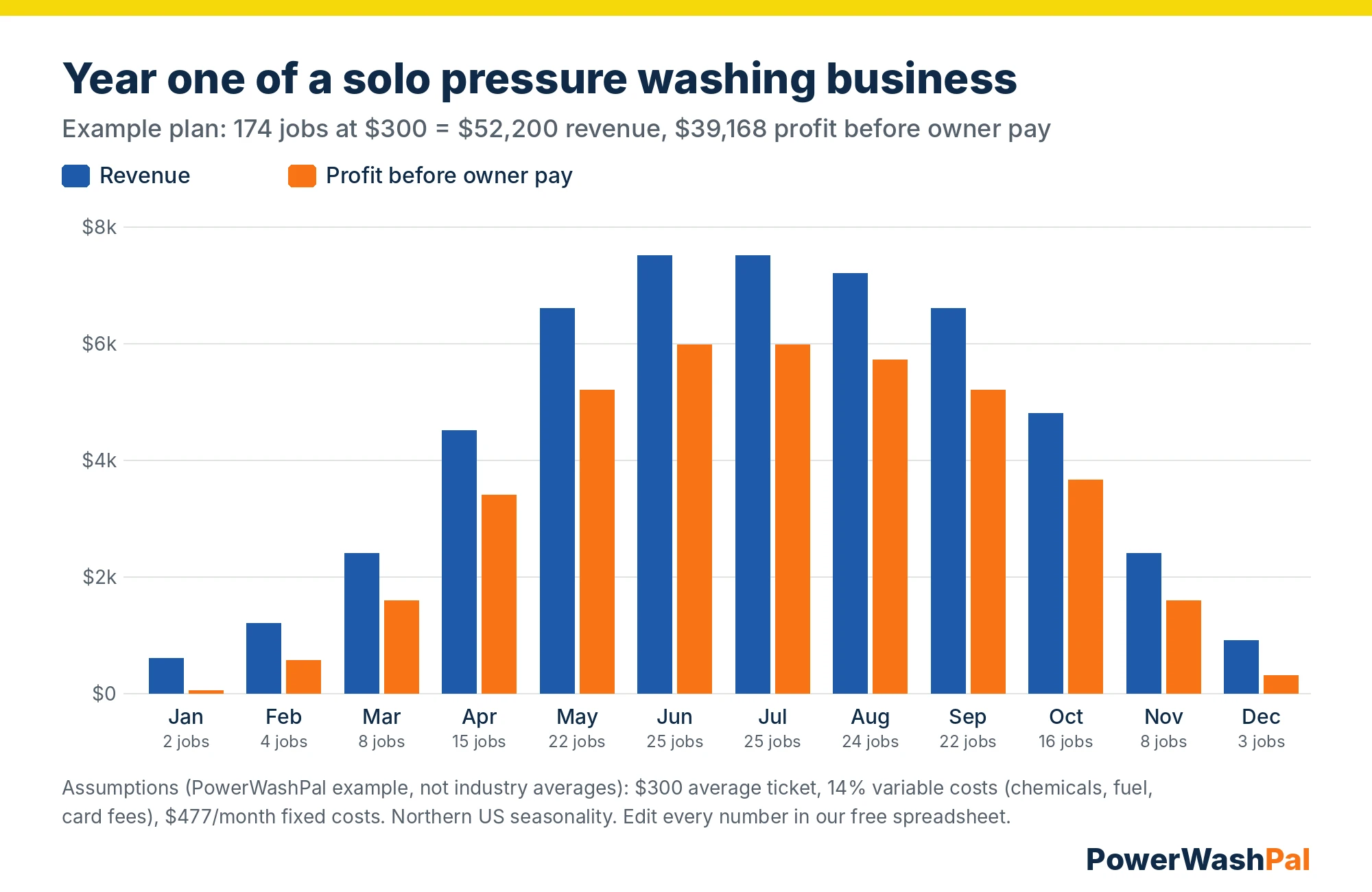
- Revenue: $52,200
- Variable costs: $7,308
- Fixed costs: $5,724
- Profit before owner pay: $39,168, or $32,490 after paying back the startup costs
Note that this is profit before you pay yourself and before income and self-employment taxes. It also assumes you’re doing the work alone. Adding a helper raises capacity but adds labor, payroll taxes and workers’ comp.
Break-even
Each $300 job leaves $258 after variable costs. At $477 a month in fixed costs, you break even at 2 jobs a month, and about 26 jobs pay back the startup costs. To pay yourself $50,000 a year on top of fixed costs, you need about 216 jobs at that ticket. That last number is the useful one: it tells you whether your marketing plan can realistically produce enough work, or whether you need a higher average ticket (roofs, commercial contracts, add-ons) instead of more jobs.
9. Milestones
End with a dated list for the first year: registration and insurance done, equipment bought and tested, website and Google profile live, first 10 paying jobs, 25 reviews, first commercial contract, first hire. It keeps you honest, and it shows a lender you have a plan beyond the numbers.
Tips for a plan that gets used (or funded)
- Use local numbers. “There are 18,000 single-family homes in my three zip codes” beats “the market is large.”
- Be conservative on jobs, honest on costs. Most first-year plans overestimate how fast work comes in.
- Show your pricing math. A sample quote for a typical house tells a lender you know the trade.
- Plan the slow season. Winter cash flow, holiday lights or gutter cleaning, and a cash buffer.
- Update it every winter. Compare actual jobs and costs to the plan and reset next year’s targets.
Related guides
- How to start a pressure washing business
- Pressure washing equipment list
- How much to charge for pressure washing
- Pressure washing business insurance
- Free pressure washing contract template
- Best pressure washing software
- Pressure washer trailer setup guide
FAQ
Do I need a business plan to start a pressure washing business?
Not legally. But a short plan forces you to price your services, estimate costs and figure out how many jobs you need, which is the difference between a business and an expensive hobby. You’ll need a full plan if you apply for a bank or SBA loan.
How much does it cost to start a pressure washing business?
A lean solo start with your own truck runs roughly $3,000 to $7,000; our sample plan comes to $6,678 including a $1,000 cash buffer. A trailer rig or a van pushes it much higher.
How much can a pressure washing business make in its first year?
It depends on your market, pricing and how fast you get customers. Our sample plan shows $52,200 in revenue and about $39,000 before owner pay from 174 jobs, but treat that as an example to adjust, not a forecast.
Is this business plan template free?
Yes. The Word, PDF and Excel files are free to download and edit, with no email required.
What’s the difference between a pressure washing and a power washing business plan?
None in practice. “Power washing” usually means hot water washing and “pressure washing” cold water, but customers use the terms interchangeably, and the plan is the same.
How long should a pressure washing business plan be?
Five to ten pages for your own use, 15 to 25 with appendices for a lender. Clear numbers matter more than length.