Disclosure: PowerWashPal may earn a commission if you buy through links on this page, at no extra cost to you. This template is general information, not legal advice. Read how we make money.
Updated October 2026.
Most pressure washing contracts get written the week after something goes wrong: a homeowner says you streaked their siding, a property manager won’t pay for a missed visit, or a customer cancels the morning your crew pulls into the driveway. A one-page agreement signed before the job would have settled every one of those in a single text.
Below is a free pressure washing contract template you can download as a Word file or PDF, edit with your business name and use on your next job. It covers residential work, includes an addendum for recurring commercial accounts, and comes with a pre-job condition checklist and the FTC cancellation notice you need for sales made at a customer’s home. After the download links, we walk through every section so you know what to change and why it’s there.
Free pressure washing contract template (6 pages)
Service agreement + recurring/commercial addendum + pre-job condition checklist + Notice of Cancellation. No email required.
What’s in the template
The download is a fill-in-the-blanks contract. Anything in [brackets] or on a blank line is yours to change. Here’s what each page does:
- Pages 1–3: Service agreement. Fourteen sections, from parties and scope of work to signatures. This is the part every customer signs.
- Page 4: Addendum A, recurring or commercial service. Visit frequency, term, auto-renewal, after-hours access, net payment terms and annual price changes. Use it for storefronts, restaurants, HOAs, gas stations and property managers.
- Page 5: Pre-job condition checklist. Twelve things to check and photograph with the customer before you pull the trigger, like chalking siding, fogged window seals and old etching on concrete.
- Page 6: Notice of Cancellation. Two copies of the cancellation form required by the FTC’s Cooling-Off Rule when you sell a job at the customer’s home.
Do you really need a contract for pressure washing?
For a $150 driveway, a written quote with your terms attached is usually enough. Once you’re washing houses, roofs or anything commercial, a signed agreement is worth the two minutes it takes. Here’s why:
- Damage claims. Cleaning exposes problems that were already there: oxidized siding, paint that was barely hanging on, window seals that were already failing. Without a pre-existing conditions clause and before photos, it’s your word against the customer’s.
- Getting paid. A deposit and a clear due date cut down on “I’ll pay you next week.” Commercial clients expect net terms in writing anyway.
- Scope creep. “While you’re here, can you hit the back patio?” is fine when the contract says extra work gets priced before you do it.
- Bigger clients ask for it. Property managers and HOAs often won’t hire a contractor without a signed service agreement and a certificate of insurance.
A contract won’t replace insurance, and it won’t save you from your own negligence. What it does is put the normal risks of the job in writing so neither side is surprised.
What pressure washing contracts should include
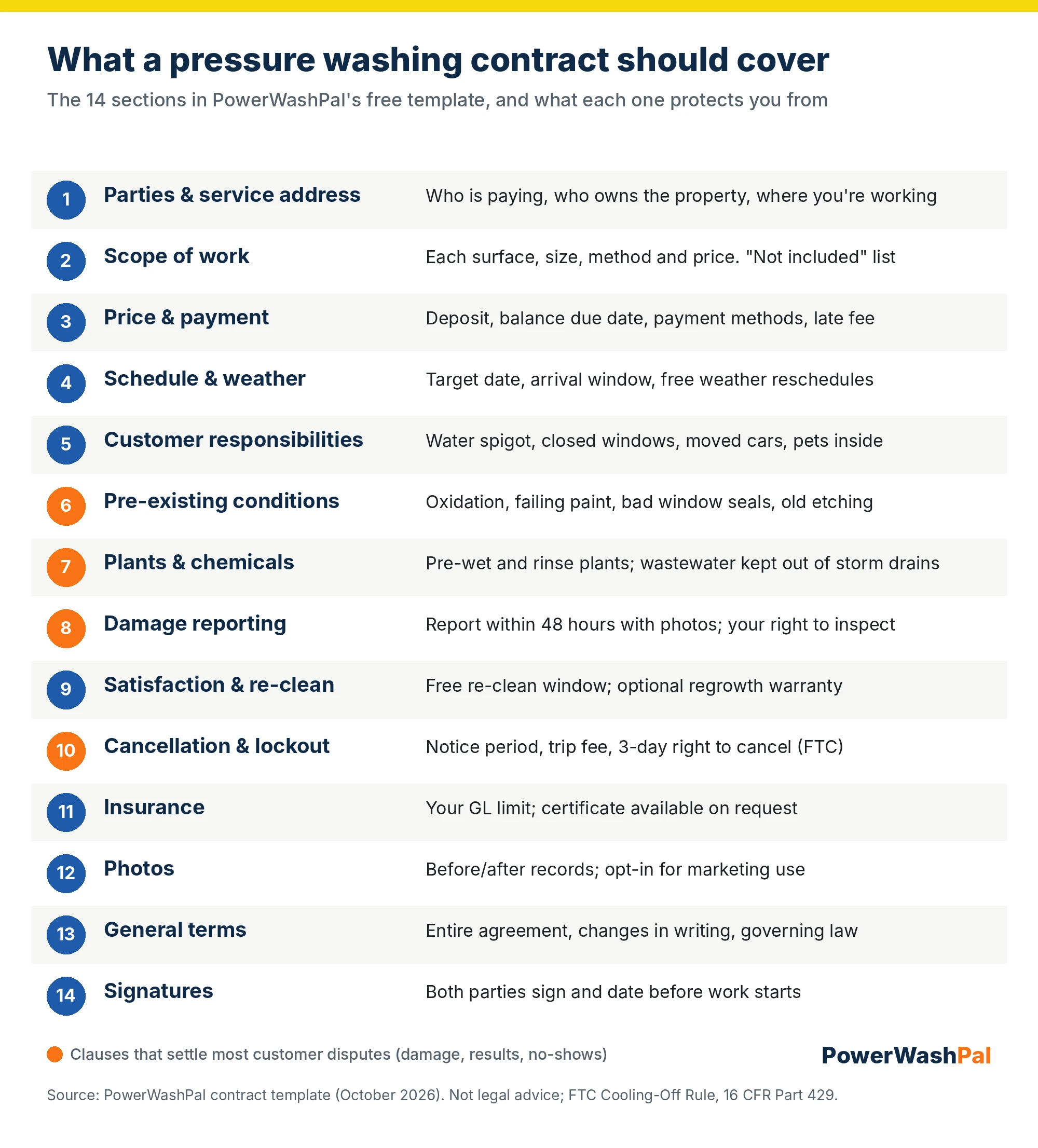
These are the sections in our template, in order, with notes on how to fill them in.
1. Parties and property
Your legal business name, address, phone and email; the customer’s name, service address and billing address. Add a line confirming the customer owns the property or has permission to authorize the work. That matters for rentals, condos and HOA-maintained buildings, where the person who calls you isn’t always the person who can say yes.
2. Scope of work
This is where most disputes start, so be specific. The template has a row for each common service (house wash, roof, flatwork, deck or fence, gutter brightening, windows, stain treatment) with columns for the area, the method and the price. Write the square footage or linear feet you measured, and say whether you’re soft washing or pressure washing each surface.
Just as important is the “not included” line: sealing, painting, repairs, interior windows, and rust, oil or fertilizer stain removal unless you listed it. If you need help putting numbers in the price column, our pressure washing estimate calculator and pricing guide cover per-square-foot rates for each surface.
3. Price and payment
Fill in the total, the deposit, when the balance is due and how you accept payment. The template also says the price is based on the conditions you saw at the estimate. If the job turns out to be very different (a second story nobody mentioned, heavy moss on the north side), you explain the change and get an OK before doing the extra work. That one sentence prevents a lot of awkward invoices.
A few notes on fees. Credit card surcharges are restricted in some states, and late fees are capped by state law, so check yours before you fill in those blanks.
4. Schedule and weather
Give a scheduled date and an arrival window instead of an exact time. Then reserve the right to reschedule for rain, high wind or freezing temperatures at no cost to the customer. Also say whether the customer needs to be home. For most house washes they don’t, as long as the water and gates are accessible.
5. Customer responsibilities
A short list of things the customer agrees to do before you arrive: provide a working spigot, close windows, move cars and patio furniture, keep pets inside, and tell you about known problems like leaking windows, loose siding, landscape lighting or a septic system. When a crew shows up to a locked gate and a car parked on the driveway, this is the clause that backs up your trip fee.
6. Pre-existing conditions and results
This is the clause that protects you most. It lists the problems cleaning can reveal but doesn’t cause, such as chalking or oxidized siding, failing paint, worn caulk, fogged window seals and old etching or “zebra striping” on concrete. It also covers stains you’ll try to remove but can’t guarantee (rust, oil, fertilizer, tannin, efflorescence) and the fact that mold and algae eventually grow back.
Pair it with the condition checklist on page 5. Walk the property with the customer, check the boxes, take dated photos and get their initials. It takes five minutes and it’s the best evidence you’ll have if a claim ever comes up.
7. Plants, property and cleaning solutions
Say that you pre-wet and rinse landscaping, use labeled cleaning solutions according to the label, and follow local wastewater rules. Many cities restrict wash water going into storm drains, and commercial sites often require water recovery, so the customer should point out drains, ponds and wells. The clause makes you responsible for damage caused by your own negligence, which is fair and easier to enforce than a promise that you’re never responsible for anything.
8. Damage reporting
Give the customer a window to report damage (48 hours is common), require photos, and keep the right to inspect before you pay for anything. You then choose whether to repair it, pay a qualified pro or reimburse the reasonable cost. This stops the “my gutter was fine until you came” call three weeks later.
9. Satisfaction and re-cleaning
Offer a free re-clean if the customer reports a problem within a set number of days. It costs you a short return trip and it turns a potential bad review into a good one. If you sell roof or house washes with a regrowth warranty, put the length in writing here.
10. Cancellation, lockouts and the 3-day rule
Set a notice period for cancellations (24 to 48 hours is typical) and a trip fee for lockouts, when the crew arrives but can’t work because there’s no water, a locked gate or cars in the way.
If you close sales at the customer’s home, read this part carefully. Under the FTC’s Cooling-Off Rule, a sale of $25 or more made at the buyer’s home gives them until midnight of the third business day to cancel for a full refund. You have to tell them about that right in the contract and hand them two copies of a cancellation form. The template includes the required statement near the signatures and a two-copy Notice of Cancellation on page 6. Sales made entirely by phone, online or at your place of business aren’t covered by the federal rule, but some states have their own home-solicitation laws with longer periods. Check the FTC’s summary of the rule and your state’s version.
11. Insurance
State your general liability limit and that a certificate is available on request. Most small exterior cleaning businesses carry $1 million per occurrence. If you have employees, note workers’ comp too. Our pressure washing insurance guide covers what each policy costs.
12. Photos
You’ll want before and after photos for your records either way. Using them in marketing is different, so the template makes it an opt-in checkbox and promises you won’t show house numbers, plates or people.
13. General terms
The boilerplate: you’re an independent contractor, this document is the whole agreement, changes must be in writing (a text or email counts), and your state’s law applies. Fill in your state.
14. Signatures
Both of you sign and date before work starts. An e-signature in your field service software counts too (more on that below).
Residential vs. commercial pressure washing contracts
The main agreement works for both, but commercial and recurring work brings a few extra terms. That’s what Addendum A is for.
| Term | Residential one-time job | Commercial / recurring |
|---|---|---|
| Pricing | One total, by surface | Price per visit, per location |
| Payment | Deposit + balance on completion | Monthly invoice, net 15–30 |
| Schedule | One date, arrival window | Weekly / monthly / quarterly, often after hours |
| Term | Ends when the job is done | Fixed term, auto-renewal, notice to terminate |
| Insurance | Certificate on request | Often must name client as additional insured |
| Wastewater | Rinse plants, avoid drains | Water recovery may be required on site |
| 3-day cancellation notice | Needed if sold at the home | Usually not (business purchase) |
Recurring commercial contracts are where the steady money is. Our pricing guide notes that recurring agreements are usually priced 15–30% below one-time rates, and the guide to getting pressure washing customers covers how to land them.
How to use the template
- Download the Word file and replace every [bracket] with your details. Add your logo at the top if you have one.
- Set your defaults: deposit percentage, payment terms, cancellation notice, trip fee, re-clean window and your state.
- Have a local attorney review it once. Contract, late fee and consumer protection rules vary by state. A one-time review usually costs far less than one disputed job.
- Save a master copy and fill in a fresh one per job: scope, price, date and walk-around notes.
- Walk the property with the customer, fill in the condition checklist and take photos.
- Get it signed before you start, on paper or by e-signature, and give the customer a copy. For sales at their home, include both copies of the Notice of Cancellation.
Sending contracts from your software
Printing contracts gets old once you’re doing more than a few jobs a week. Field service software lets you put your terms on every quote and have customers approve them online. In Jobber, for example, you can add your standard terms to the contract/disclaimer section of quotes and invoices, and customers approve the quote online through the client hub. Housecall Pro offers online estimate approval too. Either way, you keep a time-stamped record of what the customer agreed to.
A practical setup: paste sections 3 through 13 of the template into your quote terms, and keep the condition checklist and Addendum A as attachments for the jobs that need them. Our pressure washing software comparison and Jobber review cover which tools handle quotes, approvals and deposits best.
Common contract mistakes
- A vague scope. “Wash house” invites arguments. “Soft wash siding, soffits and trim, 2,200 sq ft, two stories, front porch ceiling included” doesn’t.
- No before photos. The pre-existing conditions clause is much weaker without dated photos.
- Guaranteeing stain removal. Rust and oil stains are often permanent. Promise a good-faith attempt, not a result.
- Skipping the cancellation notice on door-to-door or at-home sales. Leaving it out breaks the federal rule, and in some states it gives the customer longer to cancel.
- Copying a contract from another state without checking your own rules on late fees, card surcharges and home solicitation sales.
- Signing after the work. A contract signed once the driveway is already clean protects nobody.
Related guides
- How to start a pressure washing business
- How much to charge for pressure washing
- Pressure washing estimate calculator
- Pressure washing business insurance
- Roof cleaning cost (and what to charge)
- Best pressure washing software
- Best field service invoice software
- Commercial pressure washing prices (2026)
- Free pressure washing price list template (Word + PDF)
FAQ
Is this pressure washing contract template really free?
Yes. Download the Word or PDF file, edit it and use it for your business. No email or signup required. If you share it, a link back to this page is appreciated.
Is the template legally binding?
A contract is generally binding when both parties agree to clear terms and sign it, but rules vary by state. Treat this as a starting point and have a local attorney review your final version. This page isn’t legal advice.
Do I need a different contract for commercial pressure washing?
Use the same agreement and attach Addendum A. It adds visit frequency, term and renewal, termination notice, net payment terms, after-hours access and additional insured requirements.
Can customers sign pressure washing contracts electronically?
In most cases, yes. The federal E-SIGN Act gives electronic signatures the same legal effect as paper ones for most contracts. Field service apps like Jobber and Housecall Pro let customers approve quotes online, which keeps a record of what they agreed to.
What’s the difference between a pressure washing contract and an estimate?
An estimate tells the customer what the job should cost. A contract adds the terms: payment, scheduling, responsibilities, damage, cancellation and signatures. Many companies combine the two by attaching their terms to the estimate and asking the customer to approve it.
How long should a commercial pressure washing contract last?
Twelve months with automatic renewal and a 30-day termination notice is a common setup. It gives you predictable revenue and gives the client an easy way out, which makes them more likely to sign.