Disclosure: PowerWashPal may earn a commission if you buy through links on this page, at no extra cost to you. As an Amazon Associate we earn from qualifying purchases. Read how we make money.
Updated October 2026.
A good pressure washer trailer setup does three things: it carries enough water to keep your pump fed, it tows safely when that water is full, and it lets you pull hose and start spraying in under five minutes. Most first builds get the first and third parts right and the second part wrong, because water is heavy. A 225-gallon tank holds about 1,877 pounds of water, which is close to the entire payload of a small single-axle utility trailer.
This guide walks through a pressure washing trailer setup in the order you should plan it: weight first, then the trailer, tank, layout and plumbing, then what it all costs. We didn’t build a rig for this article. The numbers come from manufacturer and dealer pages, trailer listings and contractor forums, and we cite them as we go.
Start with weight, not equipment
Water weighs about 8.34 pounds per gallon. That one number decides your trailer, your axle count, whether you need brakes, and sometimes which truck can pull it.
| Water tank (full) | Water weight | Trigger time at 4 GPM | Trigger time at 8 GPM |
|---|---|---|---|
| 100 gallons | 834 lb | 25 min | 13 min |
| 200 gallons | 1,668 lb | 50 min | 25 min |
| 225 gallons | 1,877 lb | 56 min | 28 min |
| 325 gallons | 2,711 lb | 81 min | 41 min |
| 525 gallons | 4,379 lb | 131 min | 66 min |
Trigger time assumes no refill. On most residential jobs you’ll also have a spigot feeding the tank, so the tank works as a buffer rather than your only supply.
Now add everything else: the tank itself, the pressure washer (a 4 GPM belt-drive unit like the BE B4013HABG is about 174 lb), hose reels full of hose, a surface cleaner, fuel, chemicals and a soft wash setup. On a small trailer, those “small” items add up to several hundred pounds.
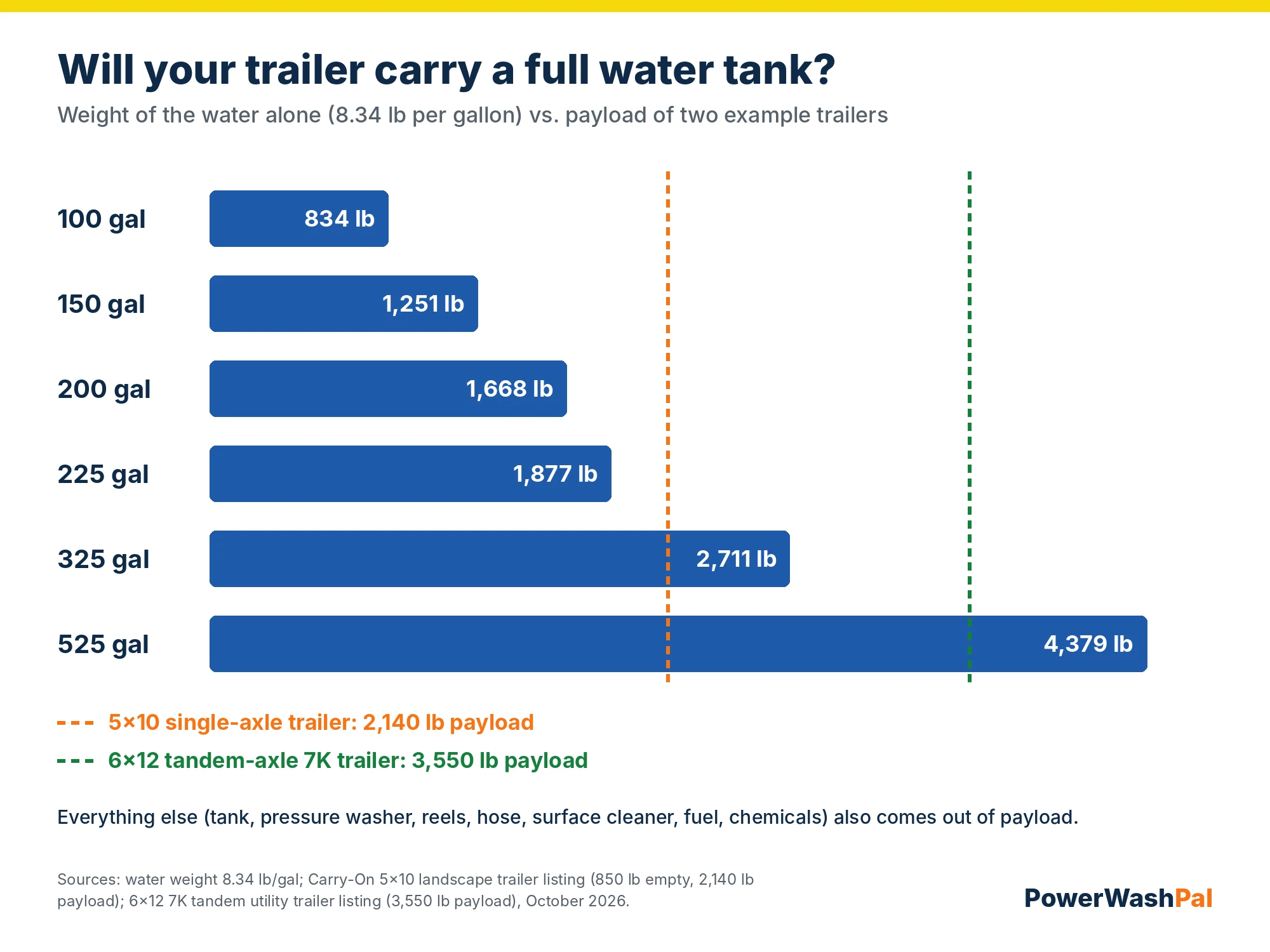
Here’s the math on a real example. A Carry-On 5×10 landscape trailer is listed at 850 lb empty with a 2,140 lb payload. Put a 225-gallon tank (1,877 lb of water) and a 174 lb machine on it and you’re at 2,051 lb, leaving about 90 lb for the tank, reels, hose, surface cleaner and fuel. That trailer is overloaded before you leave the shop. The same trailer with a 100- to 150-gallon tank works fine.
Compare a 6×12 tandem-axle trailer with a 7,000 lb GVWR and electric brakes, listed in October 2026 at $3,665 with a 3,550 lb payload. It carries a 225-gallon setup with room to spare, and even a 325-gallon tank if you keep the rest of the rig light.
Choosing the trailer
- 5×8 or 5×10 single axle (about 3,000 lb GVWR): fits residential driveways and tows behind a half-ton pickup or a large SUV. Realistic water capacity is 100 to 150 gallons once everything else is loaded.
- 6×10 or 6×12 tandem axle (7,000 lb GVWR): the most common choice for a full-time rig. Room for a 200- to 325-gallon tank, a pressure washer, two or three reels and a soft wash system. Tandem axles also handle a blowout better.
- 7×14 and larger: for 525-gallon tanks, hot water units and multi-gun commercial setups. You’ll need a three-quarter-ton truck or bigger.
Open vs. enclosed: most contractors run open trailers. Engines get airflow, everything is easy to reach, and the trailer weighs less. Enclosed trailers protect equipment from theft and weather and look cleaner to commercial clients, but they need real ventilation for the engine and burner, and the box adds weight that comes out of your payload.
Brakes: trailer brake laws are set by each state. Brakes are required above 1,500 lb in states like California and Oregon, above 3,000 lb in most states, and at higher thresholds in a few others, and most states also require a breakaway system. With a full water tank you’ll be over the line in nearly every state, so plan on electric brakes and a brake controller in the truck. Check your state’s rule before you buy (RV Travel keeps a state-by-state list).
Water tank: size and type
- 100 to 150 gallons: a buffer tank for residential work where you’ll always have a spigot. It smooths out the supply and protects the pump.
- 200 to 325 gallons: the sweet spot for most full-time rigs. Enough to finish a driveway or house wash without waiting on a weak spigot, and enough to start a job while the tank refills.
- 525 gallons and up: commercial flatwork, fleet washing and sites with no water. You need a heavy tandem trailer for this.
Why carry water at all if the customer has a spigot? Because a typical outdoor faucet often delivers 5 GPM or less, and an 8 GPM machine running straight off a garden hose will starve and cavitate the pump. Even a 4 GPM machine can be short on a long hose run or low water pressure.
Use a leg tank (a horizontal tank with flat “legs” molded in). It sits low, doesn’t roll, and the legs give the straps something to grip. Prices we saw in October 2026: a Norwesco 225-gallon horizontal leg tank at $1,099.99 at Tractor Supply, and a 235-gallon elliptical leg tank at $787.32 at Sprayer Depot. Get a baffled tank or keep it close to full or close to empty when you tow, because a half-full tank surges hard under braking.
Layout: where everything goes
The two rules that matter most are weight placement and reach.
- Water tank centered over or just ahead of the axles. It’s the heaviest item and it changes weight all day, so it belongs where it affects tongue weight the least.
- About 60% of the load ahead of the axle, 40% behind. Aim for tongue weight of 10 to 15% of the loaded trailer. A tail-heavy trailer sways at highway speed, especially with a full tank behind the axle.
- Pressure washer next to the tank, with controls facing the curb side. You want to start the engine and check oil without climbing over hose.
- Hose reels at the rear or curb side, so you can pull hose straight off the back toward the house. Stacked reels save space on a 5-foot-wide trailer.
- Soft wash tank and pump on the opposite side from the engine to balance side-to-side weight, and away from engine heat.
- Surface cleaner, ladders and wands on racks or holsters so nothing slides. Loose gear on a trailer floor gets damaged and damages hose.
Bolt engines and pumps down with Grade 8 hardware and backing plates, use rubber isolators under the engine mounts, and strap tanks with heavy ratchet straps or steel bands. A 225-gallon tank that shifts in a hard stop weighs as much as a small car.
Plumbing order
The order of parts from the tank to the gun matters more than the brand of each part:
- Tank outlet with a full-port ball valve, so you can shut off supply for service.
- Strainer or inlet filter sized for your pump’s flow. Debris in the tank is the most common cause of a damaged pump.
- Suction hose, wire-reinforced and non-collapsible, sized to the pump inlet (1 inch or larger for high-flow pumps). Not a garden hose.
- Pump, with the unloader bypass line routed back to the tank rather than looping into the pump inlet. A bypass loop on the pump heats the water during long trigger-off periods and cooks the seals.
- Downstream injector after the pump outlet if you apply detergent or mild bleach through the pressure line. Our soft wash system guide covers when a separate 12V pump is the better choice.
- High-pressure hose reel with a swivel rated above your machine’s PSI.
- Float valve on the tank fill, so a spigot or hydrant tops it off automatically while you work.
Pressure-test every fitting before your first job, and keep thread sealant out of the pump inlet.
Equipment checklist
A typical cold-water trailer rig includes:
- Pressure washer: 4 GPM or more, belt drive, triplex pump. See our best commercial pressure washer picks. The NorthStar 4200 PSI / 3.5 GPM is one of the few pro-style units sold on Amazon. Check price on Amazon
- Pressure hose reel with 150 to 200 ft of 3/8″ hose. The Coxreels 112-3-150 is a common trailer reel. Check price on Amazon More options in our hose reel guide.
- Supply or soft wash reel for 1/2″ hose, like the Coxreels 1125-4-100. Check price on Amazon
- Surface cleaner, 20 inches for a 4 GPM machine. The BE Whirl-A-Way is a standard pick. Check price on Amazon
- Downstream injector, like the General Pump injector. Check price on Amazon
- Soft wash system (optional on day one): a 12V pump, chemical tank and its own reel.
- Plumbing: ball valves, strainer, suction hose, float valve, bypass line and quick-connects.
- Mounting: Grade 8 bolts, isolators, straps or bands, wand holsters, a ladder rack.
- Safety and extras: a fire extinguisher, wheel chocks, LED work lights, and a spare tire.
Our full pressure washing equipment list covers nozzles, guns and safety gear.
What a pressure washer trailer setup costs
Prices vary a lot by region and by how much you build yourself. These are planning ranges based on the listings we checked in October 2026 and the equipment prices in our other guides:
| Item | Budget build | Mid build | Notes |
|---|---|---|---|
| Trailer | $1,500–$2,500 (used or 5×10) | $3,500–$4,500 (6×12 tandem, brakes) | New 6×12 7K tandem listed at $3,665 |
| Water tank + bands | $300–$600 (100–150 gal) | $800–$1,300 (225–325 gal) | 225-gal leg tank $1,099.99 at Tractor Supply |
| Pressure washer | $1,200–$1,800 | $1,900–$3,500 | BE 4 GPM belt drive $1,934.94 at Kleen-Rite |
| Hose reels + hose | $300–$600 | $800–$1,500 | Stainless reels cost more |
| Surface cleaner | $150–$300 | $350–$700 | |
| Soft wash system | $0 (add later) | $1,000–$1,500 | Remco 12V skid $1,495 at CleanFreak |
| Plumbing, mounting, misc. | $300–$500 | $500–$1,000 | Our estimate |
| Total | about $3,750–$6,300 | about $8,850–$14,000 |
Turnkey rigs cost more because someone else did the welding, plumbing and wiring. One example: Southeast Softwash listed a complete pressure and soft wash trailer build (6×12 or 7×16 tandem with brakes, 200-gallon water tank, 100-gallon SH tank, two 24V soft wash systems, a 5.5 GPM pressure washer, stainless reels and a 20″ surface cleaner) at $24,999 in October 2026. Hot water units add several thousand dollars more.
If you’re still deciding whether a trailer belongs in your first-year budget, our pressure washing business plan template has a startup cost sheet you can plug these numbers into, and our guide on how to start a pressure washing business explains when it makes sense to upgrade from a truck bed setup.
Insurance and registration
Register and title the trailer in your state, and tell your insurer about it. Your commercial auto policy should cover the trailer while it’s attached to the truck, and an inland marine or equipment policy covers the gear on it, including theft from a job site. A loaded rig can easily be worth more than the truck that pulls it. Our pressure washing insurance guide covers what each policy costs.
Common trailer setup mistakes
- Buying the tank before checking payload. Do the 8.34 lb/gal math first.
- Towing a half-full tank without baffles. The water surges forward when you brake.
- Too much weight behind the axle. It lightens the tongue and causes sway.
- Looping the bypass back into the pump inlet instead of the tank.
- Using garden hose for suction. It collapses and starves the pump.
- Skipping winterization. Drain the tank, pump and lines, or run RV antifreeze through them. A cracked pump manifold costs far more than a jug of antifreeze.
Related guides
- Best surface cleaner for pressure washing pros
- Best commercial pressure washer
- Best pressure washer hose reel
- Best soft wash system
- Pressure washing equipment list
- How to start a pressure washing business
- Pressure washing business plan template
- Hot water heater for pressure washer (hot boxes vs hot units)
FAQ
What size water tank do I need for a pressure washing trailer?
For residential work with a spigot on site, 100 to 225 gallons is plenty. For commercial flatwork or sites without water, 325 to 525 gallons. Match it to your trailer’s payload first: every 100 gallons adds 834 lb.
Do I need a tandem axle trailer for pressure washing?
Not for a small buffer tank. Once you carry 200 gallons or more with a commercial machine and reels, a tandem-axle trailer with a 7,000 lb GVWR is the safer choice. It has the payload, it usually comes with brakes, and it’s more stable if a tire fails.
Does a pressure washing trailer need brakes?
Almost always once the tank is full. Most states require trailer brakes above 3,000 lb gross weight, and some, like California and Oregon, above 1,500 lb. Check your state’s rule.
How much does it cost to build a pressure washing trailer?
A budget build runs roughly $3,750 to $6,300, and a mid-range 6×12 rig with soft wash about $8,850 to $14,000. Turnkey builds cost more: one complete pressure and soft wash trailer was listed at $24,999 in October 2026.
Can I run my pressure washer straight from the customer’s spigot?
A small machine can, but a typical spigot often gives 5 GPM or less. A buffer tank with a float valve keeps a 4 to 8 GPM pump fed and protects it from cavitation.
Should I build a trailer or a truck bed skid?
A skid keeps everything in your truck and is easier to park. A trailer carries more water, frees up the truck and is easier to upgrade, but it’s harder to back into tight driveways. Most solo operators with a 4 GPM machine start with a skid or a small trailer and move to a 6×12 when they add soft washing or commercial work.