Disclosure: PowerWashPal may earn a commission if you buy through some links on this page, at no extra cost to you. It doesn’t change what we recommend.
Updated November 2026
Commercial pressure washing prices usually land between $0.10 and $0.35 per square foot for basic flatwork and storefronts, and $0.40 to $1.00 per square foot once you’re fighting grease, gum or graffiti. Parking lots are often bid at $8 to $20 per space, dumpster pads at $0.75 to $1.00 per square foot, and a recurring monthly contract runs about $100 to $600 a month, based on the 2026 cost guides from HomeGuide and Housecall Pro. If you bill by the hour instead, commercial pressure washing rates run about $50 to $150 per tech, and full crews often charge $100 to $200 an hour.
Those numbers are a starting point, not your price. Commercial work gets won or lost on the stuff a residential quote never touches: night hours, water reclaim, insurance certificates, and how many times a year you’ll be back. Below is the price chart, then the math we’d use to turn it into a bid you won’t regret.
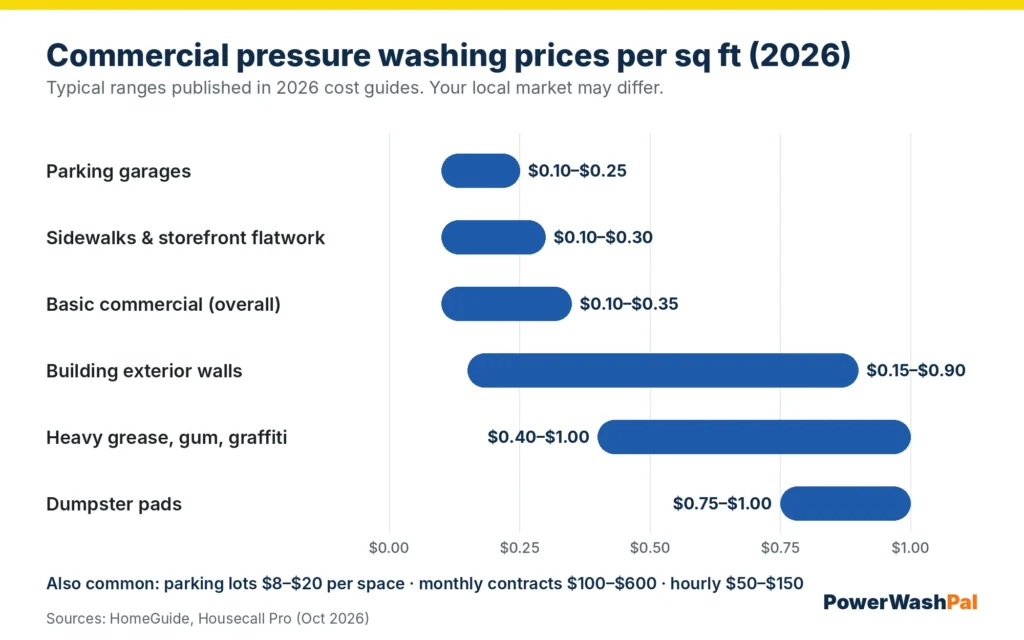
Commercial pressure washing price chart (2026)
| Job | Typical price | How it’s usually bid |
|---|---|---|
| Sidewalks, walkways, storefront flatwork | $0.10–$0.30 per sq ft | Per sq ft |
| Building exterior walls | $0.15–$0.90 per sq ft | Per sq ft of wall, lift extra |
| Heavy grease, gum, graffiti | $0.40–$1.00 per sq ft | Per sq ft, hot water |
| Dumpster pads / enclosures | $0.75–$1.00 per sq ft | Per pad or per sq ft, often monthly |
| Parking garages | $0.10–$0.25 per sq ft | Per sq ft or per level |
| Parking lots | $8–$20 per space | Per space |
| Small commercial area (under 2,000 sq ft) | $200–$500 | Flat fee |
| Large property (plaza, business park) | $600–$3,000+ | Custom quote |
| Hourly (mixed areas, tough access) | $50–$150 per hour | Per hour, per tech |
| Recurring service contract | $100–$600 per month | Monthly |
If you mostly do houses, notice what’s missing: per-square-foot rates on commercial flatwork are often lower than residential. That’s not a typo. You’re doing bigger, flatter areas with a surface cleaner, so the rate drops while the ticket goes up. Our residential pricing guide has the house-side numbers if you want to compare.
Commercial pressure washing equipment that pays for itself on flatwork
Here’s the catch with those per-square-foot prices: they only pay off if you can move fast. On sidewalks, plazas and parking lots, a 20-inch surface cleaner covers ground a lot quicker than a wand and leaves fewer stripes. On greasy dumpster pads, hot water does most of the scrubbing for you. Here’s what we’d look at first (affiliate links):
- BE Whirl-A-Way 20″ surface cleaner, 4,000 PSI: Check price on Amazon
- SIMPSON 80182 20″ industrial surface cleaner, hot-water rated: Check price on Amazon
- NorthStar hot water pressure washer, 2,750 PSI, 2.5 GPM, 230V: Check price on Amazon
Still picking the machine itself? Our guide to the best commercial pressure washer compares hot and cold water units by GPM and price.
Cost to pressure wash a commercial building (by size)
Property managers usually ask “what’s it going to cost for my building?” not “what’s your rate per square foot?” So here’s the math done for you. These numbers multiply the basic commercial range of $0.10 to $0.35 per square foot by the area being cleaned. Bigger areas tend to land near the low end, and heavy grime pushes you toward the top or past it.
| Area cleaned | At $0.10–$0.35 per sq ft | Notes |
|---|---|---|
| Under 2,000 sq ft | $200–$500 flat | Most companies charge a minimum here |
| 3,000 sq ft | $300–$1,050 | Small retail building or one strip of walks |
| 5,000 sq ft | $500–$1,750 | Typical small strip center sidewalk |
| 10,000 sq ft | $1,000–$3,500 | Usually quoted closer to the low end |
| 25,000 sq ft | $2,500–$8,750 | Custom bid, often split over nights |
Small commercial pressure washing prices
For small jobs, like one storefront, an office entry or a single dumpster pad, the square-foot math comes out too low to be worth the trip. That’s why most guides show a flat $200 to $500 for areas under 2,000 sq ft. Set your own minimum and stick to it.
Hot water vs. cold water pricing
Hot water costs more to run (fuel, burner upkeep, slower setup), so it’s priced higher. FieldPulse’s quoting guide puts warm-water commercial work at about $0.20 to $1.15 per square foot, compared with $0.10 to $1.00 for cold. If the job is mostly oil, grease or gum, quote it as hot water work from the start.
Prices by property type
Storefronts and strip centers
Most storefront jobs are sidewalk, entry and a strip of wall or glass. For a single store, a lot of owners just set a flat minimum and move on. For a whole strip center, quote per square foot for the walks and add a line for gum removal at the entries, which is where the time actually goes. Property managers love a monthly or quarterly sidewalk plan here.
Restaurants and drive-thrus
This is grease country. Dumpster pads, back doors, drive-thru lanes and the area around the grease trap usually need hot water and a degreaser, so price them in the $0.40–$1.00 range, not the basic flatwork rate. If you don’t run hot water yet, our guide to hot water heaters for pressure washers covers what a burner adds. Many restaurants want this done monthly, after close.
Gas stations and convenience stores
Fuel islands, the pad under the canopy, entrances and the dumpster area. Oil stains and gum are the big ones. Price the pads like heavy commercial flatwork, add the canopy as a separate line if they want it, and be ready to explain how you’ll handle the runoff (more on that below).
Parking lots and garages
Per-space pricing ($8–$20) is easy for a manager to understand and easy for you to check against a satellite view. Garages get bid per square foot or per level, and they’re usually night work. Don’t forget stairwells and elevator lobbies, which take way longer per square foot than the open deck.
Apartment complexes and HOAs
Breezeways, stairs, pool decks, dumpster areas, mailbox kiosks and building washes. These are often multi-day jobs with notice letters to residents and cars that need to be moved. Price by area, then add a buffer for coordination. A yearly contract with a set schedule beats a one-off bid every time.
Fleet washing
Fleet pricing is all over the place because “wash a truck” can mean a quick rinse of a pickup or a full cab, frame and trailer. Swivl’s truck washing cost guide puts recurring fleet washes at roughly $40–$120 per vehicle depending on fleet size, and notes that a big truck-stop chain charges around $44 for a tractor and $70 for tractor plus trailer. Mobile crews have to beat the drive to that truck stop on convenience, not on price alone. The best tip we’ve seen from operators on pro forums: do a paid or free test wash first, time it, and measure your soap before you put a number in writing.
How to bid a commercial job (worked example)
Here’s a simple way to build a bid that covers your costs instead of just copying a competitor’s rate. Say a strip center wants 6,000 sq ft of sidewalks cleaned, plus two dumpster pads at 200 sq ft each.
- Measure. Use the site plan or a satellite measuring tool, then confirm on a walk-through. 6,000 sq ft of walks + 400 sq ft of pads.
- Estimate time. Use your own production rate, not someone else’s. If your 20-inch surface cleaner setup does around 1,000 sq ft an hour on that concrete including edging and rinse, that’s about 6 hours, plus 1.5 hours for the pads with degreaser, plus setup and cleanup.
- Price your labor. Two techs × 8.5 hours × your loaded hourly cost (wage, payroll taxes, workers’ comp).
- Add direct costs. Fuel for the machine and truck, chemicals, water if you’re paying for it, and any water reclaim gear.
- Add overhead and profit. Insurance, equipment wear, software, phone, your own time selling. Then add your margin.
- Sanity-check against the chart. 6,000 sq ft at $0.10–$0.30 is $600–$1,800. Two pads at $0.75–$1.00 per sq ft is $300–$400. If your cost-based number lands way outside $900–$2,200, double-check your production rate before you send it.
Want to skip the calculator math on the flatwork? Our free pressure washing estimate calculator does the square footage part for you.
Once you’re sending more than a few commercial bids a month, it’s worth moving off spreadsheets. Pressure washing business software can store each property’s measurements, turn them into a quote, and remind you when the next contract visit is due. QuoteIQ is built around exterior cleaning and has a free trial; our pressure washing software comparison covers the other options.
What changes the price on commercial jobs
- Hours. Night and weekend work is normal in commercial. Some companies build it into the rate, others add a premium. Either way, don’t do it for free.
- Water and runoff. Many cities don’t allow wash water with soap, grease or oil to go into storm drains. That can mean berms, a vacuum recovery unit and disposal, which costs real money. Ask the city before you bid, not after.
- Hot water and chemicals. Grease and oil take hot water and degreasers. Price it like the heavy work it is.
- Access and equipment. Lifts, long hoses, traffic cones, permits for lane closures. Each one is a line item.
- Insurance requirements. Commercial clients often ask for a certificate of insurance, higher limits, or to be named as additional insured. See our pressure washing business insurance guide before you say yes.
- Frequency. Monthly or quarterly work is easier each visit, so it’s normal to offer a lower per-visit price in exchange for a contract.
- Your local market. Rates in big metros with high labor costs are just higher. Use local quotes, not national averages, to set your final number.
Recurring contracts: where the real money is
One-off commercial jobs are nice. Contracts pay the bills in January. A strip center that pays $300 a month for sidewalks and dumpster pads is $3,600 a year with no new sales work, and it’s usually faster each time because the buildup never gets bad.
A few things that help when you pitch a contract:
- Offer a clear schedule (monthly, every other month, quarterly) and a per-visit price for each option.
- Price the first visit higher if the property hasn’t been cleaned in years. Say so up front.
- Put it in writing: scope, schedule, payment terms, how weather delays work, and how either side can cancel. Our free pressure washing contract template is a decent starting point.
- Send before-and-after photos with each invoice. Property managers have bosses too, and photos make your invoice easy to approve.
Common mistakes when pricing commercial work
- Using residential production rates. Gum, stains and edging slow you down more than you’d think. Time yourself on a small commercial job first.
- Forgetting the runoff plan. It’s the thing that turns a good bid into a losing job, or a fine from the city.
- Underbuying equipment. A homeowner-grade machine won’t hold up to a parking garage. If you’re moving into this work, our commercial pressure washer guide covers the GPM and pump specs that matter.
- Bidding the lowest number to “get in.” Commercial clients rarely let you raise prices a lot later. Start where you can make money.
- No minimum. Set one. A quick sidewalk job still costs you a drive, setup and breakdown.
How we put these numbers together
We pulled ranges from published 2026 cost guides (HomeGuide’s commercial pressure washing prices, Housecall Pro’s pressure washing pricing guide, Swivl’s commercial and truck washing cost guides, FieldPulse’s quoting guide and Smart Janitorial’s commercial rate breakdown) and from what operators share in public pro forums. We didn’t run these jobs ourselves, and we didn’t make up a national average. Where sources disagree, we show the range. For residential benchmarks across Angi, HomeGuide, Thumbtack and others, see our exterior cleaning price index.
Related guides
FAQ
How much do commercial pressure washers charge per square foot?
Most 2026 guides put basic commercial flatwork at about $0.10 to $0.35 per square foot. Heavy jobs with grease, gum or graffiti run about $0.40 to $1.00 per square foot.
How much should I charge to pressure wash a parking lot?
A common way to bid parking lots is per space, usually around $8 to $20 per space. Garages are more often bid at $0.10 to $0.25 per square foot.
How much does it cost to clean a dumpster pad?
Dumpster pads typically run $0.75 to $1.00 per square foot because they need degreaser and often hot water. Many restaurants and stores book them monthly.
Is commercial pressure washing cheaper than residential?
Per square foot, often yes, because the areas are big and flat. Per job, no. Commercial tickets are usually larger, and recurring contracts make them steadier.
What should a commercial pressure washing contract include?
Scope and areas, schedule and frequency, price per visit, payment terms, weather and rescheduling rules, insurance details, how runoff is handled, and how either side can cancel.
How much does it cost to pressure wash a 3,000 sq ft commercial building?
At the common $0.10 to $0.35 per square foot range, 3,000 sq ft of flatwork or wall comes to about $300 to $1,050. Expect more if it needs a lift, hot water or night work.
Does hot water pressure washing cost more?
Yes. Hot water work is usually priced higher because of fuel and burner costs. One 2026 quoting guide puts warm-water commercial work at about $0.20 to $1.15 per square foot.
How often should a commercial property be pressure washed?
It depends on traffic and grease. Restaurants often book dumpster pads and drive-thrus monthly, busy storefront sidewalks monthly or quarterly, and building exteriors once or twice a year. Recurring schedules are usually cheaper per visit.
Is there a pressure washing estimate template for commercial bids?
A simple one works: property name, areas and square footage, price per area, schedule, what’s not included, and how long the price is good for. Our free estimate calculator handles the square-foot math, and our free contract template covers the terms once they say yes.