Heads up: some links on this page are affiliate links. If you buy through them, we may earn a small commission at no extra cost to you. It never changes what we recommend. Read our affiliate disclosure.
Updated October 2026
Your soft wash pump is the heart of the rig. Get it right and you’ll lay down chemical fast, reach the second-story gables without a ladder, and go home on time. Get it wrong and you’ll spend Saturday re-priming a pump that bleach chewed up in three months.
Here’s the short version: most one-person house-washing crews do fine with a bleach-rated 12V pump around 5 to 7 GPM. If you clean a lot of roofs or tall commercial buildings, you’ll want 8 to 10 GPM, which means a 24V or gas pump. The rest of this guide shows you how to pick, what to avoid, and which pumps are worth a look.
| Pick | Type | Flow | Best for |
|---|---|---|---|
| Remco 5900 Smooth-Flo Bleach Pump | 12V demand | 7.0 GPM, 100 PSI max | Best overall 12V for house washing |
| NorthStar Soft Wash Bleach Pump | 12V | 5.5 GPM | Long days: continuous-duty rated |
| Remco Fatboy | 12V demand/bypass | 7.0 GPM, 150 PSI max | High flow at a mid price |
| Everflo EF7000 | 12V diaphragm | 7.0 GPM, 60 PSI | Budget build or spare pump |
| Comet P40 / BE SW1165 gas units | Gas diaphragm | About 11 GPM, 300 PSI | Roofs, commercial, multi-story |
What a soft wash pump does (and why your pressure washer can’t)
Soft washing lets the chemical do the work. You spray a sodium hypochlorite (SH) mix with surfactant at low pressure, let it dwell, then rinse. Kleen-Rite recommends staying in the 300 to 500 PSI range or lower, because pressure isn’t what kills the algae and mold.
A regular pressure washer pump isn’t built to have bleach running through it. That’s why many beginners start with a downstream injector: it pulls chemical into the water after the pump. It’s cheap and it works for house washing, but it dilutes your mix a lot, so it can’t put strong SH on a roof. A dedicated soft wash pump pulls straight from your chemical tank and sprays the mix at full strength. That’s the big difference. (Mixing ratios are in our soft wash chemicals guide.)
12V vs 24V vs gas: which one fits your jobs?
| 12V electric | 24V electric | Gas diaphragm | |
|---|---|---|---|
| Typical flow | About 3 to 7 GPM | Higher than 12V; some models reach about 10 GPM | About 10 to 12 GPM |
| Noise | Quiet | Quiet | Loud |
| Upkeep | Basically none; replace when worn | Low | Oil changes, diaphragms, engine service |
| Upfront cost | Lowest | Middle | Highest |
| Best for | Houses, fences, one-story roofs | Roofs and bigger homes on a quiet rig | Roofs, commercial, two or more operators |
12V pumps
These are what most of the industry starts with, and for good reason. They’re cheap, easy to swap, quiet, and there’s no oil or gas to deal with. Most are demand pumps: a pressure switch turns the motor on when you pull the trigger and off when you let go.
The catch? Dultmeier, a big sprayer parts distributor, puts the top end of 12V pumps at about 7 GPM, and that’s at low pressure. They also wear out faster, and a pressure switch that keeps cycling on and off can burn out the motor. Plan on replacing a 12V pump instead of rebuilding it.
24V pumps
A 24V setup gets you more flow and pressure than 12V without the noise of an engine. You’ll need two batteries in series (or a 24V lithium pack), so the wiring is a bit more work. It’s a nice middle ground if you do a lot of roofs in neighborhoods where a running engine at 8 a.m. gets you complaints.
Gas pumps
Engine-driven diaphragm pumps like the Comet P40 and the AR45 are the workhorses for roofs and commercial work. Kleen-Rite says gas units can easily move 10 to 12 GPM. Common packages, like BE’s SW1165 series, pair a Honda GX200 engine with a diaphragm pump rated about 11 GPM at 300 PSI.
The trade-off is cost, noise and maintenance: oil for the engine and pump, fuel, and diaphragms every so often. One more thing: California has restricted sales of new small gas engines, and Kleen-Rite notes other states may follow. Check your state and city rules before you buy a gas rig.
How much GPM do you actually need?
Flow is what gets chemical up on the second floor. Nozzle size and hose diameter matter too, but the pump sets the ceiling.
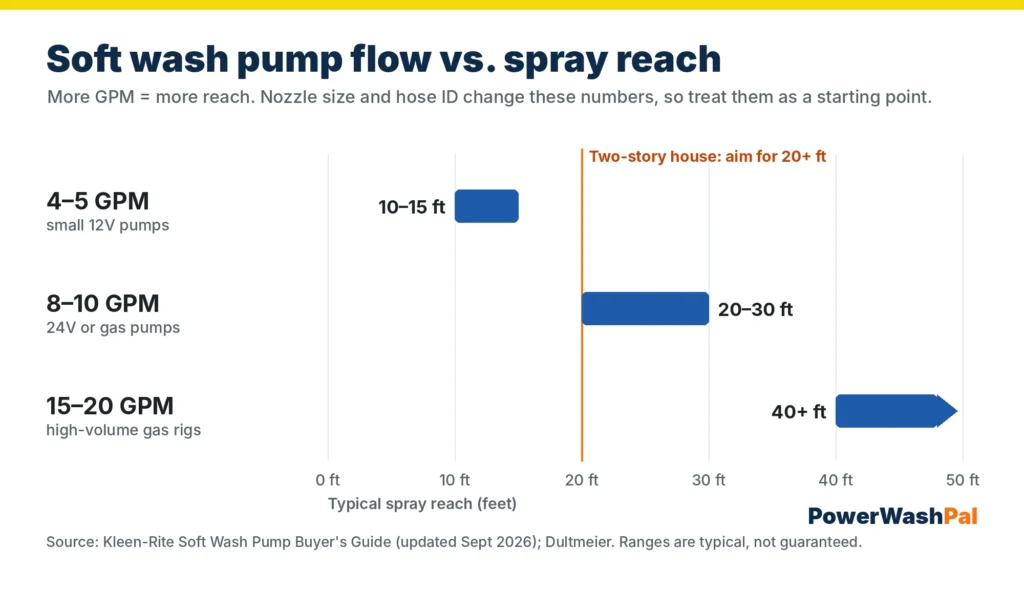
- House washing, one or two stories: 5 to 7 GPM with the right nozzle usually gets you there. Dultmeier says a two-story home needs a system that sprays at least 20 feet high.
- Roofs: Kleen-Rite recommends 8 to 10 GPM for the best results. Plenty of owner-operators still do low, one-story roofs with a 7 GPM 12V pump, but you’ll be slower.
- Commercial and multi-story: go gas, or at least 24V. Dultmeier recommends more than 5 GPM for large surfaces or when two people spray at once.
Rule of thumb: buy for the jobs you want next year, not just the ones you have today. If roofs are part of your plan, see what they pay in our roof cleaning cost guide.
Bleach-safe materials: the checklist
Bleach eats the wrong rubber fast. Before you buy any pump, check the spec sheet for these:
- Housing/manifold: polypropylene (often glass-reinforced).
- Seals, valves and diaphragms: Viton or Santoprene. Kleen-Rite and Dultmeier both list these as compatible with SH and surfactants.
- Bolts and hardware: stainless steel.
- Marketing words aren’t specs. “Chemical resistant” can mean almost anything. If the listing doesn’t name the seal material, ask the seller or check the model number with the maker.
Best soft wash pumps worth a look
We picked these from manufacturer specs, supplier guides and what owner-operators run on their rigs. Specs change, so double-check the model number before you order.
1. Remco 5900 Smooth-Flo Bleach Pump (12V): best overall 12V
This one’s built specifically for bleach, which is exactly what you want. It’s rated 7.0 GPM with a 100 PSI max and dual pressure control. Remco lists a max draw of 19 amps at 100 PSI and recommends a 25-amp fuse, so wire it with that in mind. It’s rated for intermittent duty, which fits how a demand pump runs in real life: spray, stop, move the ladder, spray again.
Good for: a solo operator’s first serious house-wash rig. Watch out for: it’s not a continuous-duty pump, so it’s not ideal for long nonstop roof runs.
2. NorthStar Soft Wash Bleach Pump (12V): best for long days
NorthStar markets this 5.5 GPM pump for bleach work. It has a 100% continuous duty rating with no cool-down needed, it can run dry without damage, and its “Motor Armor” shuts the pump off if it detects a leak. That’s a nice safety net when you’re on a ladder and can’t see the pump.
Good for: crews that spray all day. Watch out for: 5.5 GPM is less reach than a 7 GPM pump, so tall gables can be a stretch.
3. Remco Fatboy 5538 (12V): high flow, demand or bypass
The Fatboy is a five-chamber diaphragm pump rated 7.0 GPM with a 150 PSI max. It’s self-priming up to 14 feet, can run dry, and works in demand or bypass mode. It weighs about 10 pounds.
Good for: builders who want more flow from a 12V setup. Watch out for: confirm the seal material for your exact model number before you run strong SH through it.
4. Everflo EF7000 (12V): budget pick and spare
The EF7000 is a 7.0 GPM, 60 PSI diaphragm pump with a glass-reinforced polypropylene manifold. It’s self-priming up to 12 feet and uses a standard mounting pattern, so it fits a lot of sprayer tanks. It’s sold as an ag sprayer pump, not a bleach-specific one, so think of it as a budget build or a spare you keep in the truck for when your main pump dies mid-job.
Good for: getting started cheap, or a backup. Watch out for: expect a shorter life with strong SH.
5. Comet P40 or BE SW1165 gas units: for roofs and commercial work
When you’re ready for roofs every day, this is the class to look at. The Comet P40 is rated 11.5 GPM and 300 PSI max, with polypropylene manifolds, Viton seals and stainless bolts. SoftWash Technologies listed the P40 pump alone at $1,465 in October 2026, and a complete P40 sprayer at $2,170. BE’s SW1165 packages run a Honda GX200 with an 11 GPM, 300 PSI diaphragm pump. You’ll mostly find these through equipment dealers, not Amazon.
Good for: roof-heavy and commercial crews. Watch out for: noise, upkeep, and gas engine rules in your area.
Need a small pump for spot-spraying plants or pre-wetting? A 3 GPM pump like the Shurflo 2088 works for that, but it’s too small to be your main soft wash pump.
Battery math for 12V pumps
A 12V pump is only as good as the battery behind it. Use a deep-cycle marine or lithium (LiFePO4) battery, not a car starting battery.
Here’s a quick way to estimate run time. Take the battery’s usable amp-hours and divide by the pump’s amp draw. A 100Ah lead-acid battery gives you about 50 usable amp-hours if you don’t want to wreck it. At the Remco 5900’s 19-amp max draw, that’s roughly 2.5 hours of actual spraying. A demand pump only runs while you’re on the trigger, so that usually covers a full day of house washing. Lithium lets you use more of its rated capacity, so the same 100Ah lasts longer.
Carry a charger or a DC-DC charger off your truck if you’re doing back-to-back roofs.
Building the rig: pump, tank, reel and hose
The pump is one piece. A complete setup also needs:
- A chemical tank (polyethylene) big enough to hold a full day of mix.
- A hose reel and chemical-rated hose sized for your pump’s flow. See our hose reel guide.
- A gun and soft wash tips sized for your pump’s GPM.
- A filter/strainer on the suction side to protect the diaphragms.
If you’d rather buy a complete system than build one, our best soft wash system guide compares ready-made skids. Mounting it all? Check our pressure washer trailer setup guide.
Maintenance that keeps a pump alive
- Flush with fresh water after every job. Bleach sitting in the pump overnight is the #1 killer.
- Don’t let it dead-head for long. Constant on/off cycling heats the motor and wears the pressure switch.
- Clean the inlet strainer weekly. A clogged strainer starves the pump and it loses prime.
- Keep a spare. A second 12V pump is cheaper than canceling a day of jobs.
- Gas pumps: change engine and pump oil on schedule and replace diaphragms before they fail.
Safety gear and plants
Strong SH burns skin and eyes and kills plants. Wear chemical-resistant gloves and sealed goggles, pre-wet plants, and rinse them after. Our soft wash chemicals guide covers mixing and plant protection step by step.
How we compared
We didn’t lab-test these pumps. We compared published manufacturer specs (flow, pressure, duty rating, materials), buyer’s guides from equipment suppliers Kleen-Rite, Dultmeier and SoftWash Technologies, and what owner-operators commonly run. Read more about how we research and compare.
Related guides
FAQ
Is a 12V soft wash pump enough for roofs?
For low, one-story roofs, yes. A 7 GPM 12V pump can do it, just slower. For steep or two-story roofs, Kleen-Rite recommends 8 to 10 GPM, which means 24V or gas.
What’s the difference between a soft wash pump and a downstream injector?
A downstream injector pulls chemical into your pressure washer’s water after the pump, so the mix gets diluted. A soft wash pump sprays the mix straight from the tank at full strength, which you need for roofs.
How long will a 12V battery run a soft wash pump?
Divide usable amp-hours by the pump’s amp draw. A 100Ah deep-cycle battery (about 50Ah usable) at 19 amps gives roughly 2.5 hours of trigger time, which usually covers a day of house washing.
What GPM do I need for house washing?
About 5 to 7 GPM with the right nozzle handles most one- and two-story homes. Make sure your setup reaches at least 20 feet for two-story houses.
Can I run surfactant through a soft wash pump?
Yes. Pumps with polypropylene housings and Viton seals are compatible with bleach, algaecides and surfactants, according to Kleen-Rite. Flush with fresh water after each job.